
Challenging behaviours can seem pretty loud.
A student suddenly stops participating.
They push their work away, put their head down, or walk away from the activity. The lesson is interrupted, the teacher steps in, and everyone is left wondering what triggered the reaction.
However, for a student with autism, behaviour is just the surface. It may actually be indicative of a silent need that has been building up for minutes, hours, or even days.
That's why understanding challenging behaviours in autism is so important. They aren't always about refusal, attracting attention, or simply“acting out.” More often than not, they are the only messages that kids can send in that moment.
The true work begins when adults learn to read that message.
What Does “Behaviour Is Communication” Mean?
‘Behaviour is communication’ suggests that actions serve a purpose.
A child may be yelling because the room is too noisy. They may run because they find the hallway overwhelming. They may refuse to do something because they don't think they can complete the task successfully. They may cry because frustration is building up more quickly than they can express in words.
For autistic kids, behaviour is a signal. It points towards feelings like:
- frustration,
- anxiety,
- sensory overload,
- confusion,
- pain,
- discomfort,
- wanting to escape,
- or a need for assistance, attention or connection.
That's why every behaviour needs to be studied and understood. When educators start responding to the underlying needs that lead to challenging behaviour, they can provide the right autism support services during tougher times.
Why Autistic Children May Use Behaviour to Communicate
A student with autism may use behaviours to communicate for a variety of reasons. Sometimes it is language. Sometimes it is sensory issues. Sometimes it is an emotional barrier. And more often than not, several factors overlap.
Communication Differences
Some autistic students have limited verbal language. Others talk smoothly but may still have trouble with words when they're stressed, tired, anxious, or overwhelmed.
For example, a student may say, “I need help” during a calm speech session. However, she might not be able to say anything during a chaotic math block when peers are constantly talking, and multiple directions are being given all at once.
In fact, this can become even more complex when thinking about adhd and autism, where attention, impulse control, processing speed, and emotional regulation may all affect how a child responds.
You may only see the behaviour first, but the communication struggle may be hiding underneath.
Sensory Processing Differences
Many children with autism experience sensory input differently from most of us. A sound that is "normal" for one child can be painful for another. Bright light, loud/unexpected noise, crowded hallways, strong odours, scratchy clothing and too much visual clutter can all cause overwhelm.
When a child bolts from the classroom, she may not be 'avoiding work'. She may just be trying to escape a sensory environment that her body can't handle anymore.
This is why sensory activities for autism should not be treated only as rewards after compliance. Sensory supports are access tools. A movement break, quiet corner, headphones, or reduced visual distractions may help the student stay more available for learning.
Difficulty Identifying Emotions
Some students struggle to recognise their emotions or describe how they feel.
For example, they may not realise they were anxious until they've already begun screaming. Similarly, they may not recognise frustration until they've ripped a piece of paper.
They may not know how to tell you, “this is too much,” so their body does it for them.
This may show up in an ASD checklist as difficulty with emotional identification, self-advocacy, flexibility, transitions, or communication under stress. In the classroom, however, it appears as a student who needs support immediately.
Teaching access in the classroom means helping students identify/label their emotions, recognise body signals and ask for help.
Common Behaviours and What They Might Be Communicating
The same behaviour can have different meanings. Screaming may mean “I am overwhelmed” for one student and “I need attention but do not know how to ask” for another.
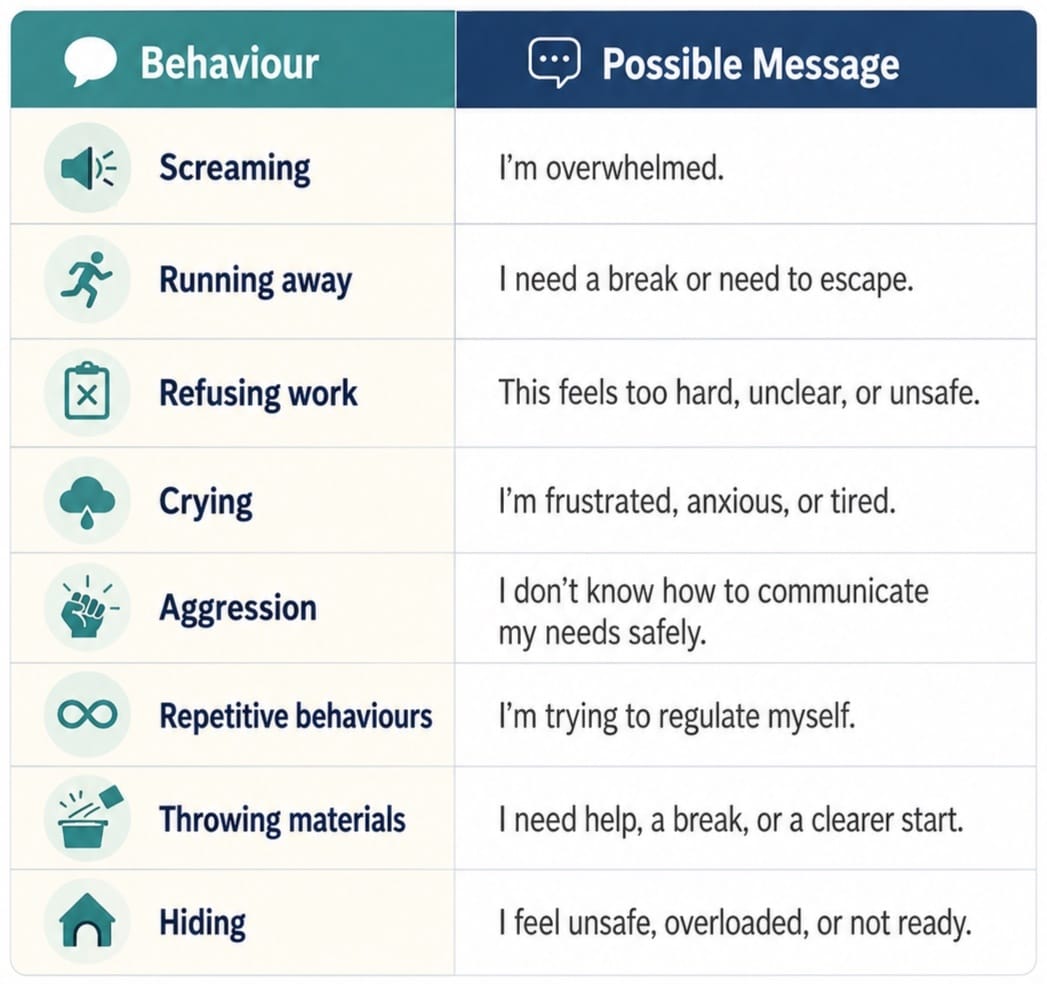
This table is a starting point, not a script. “Refusing work” may look like defiance, but it may mean the task has too many steps or the student missed the first direction.
When teams take time to understand challenging behaviours, they often find the child is not trying to create a problem. The child is trying to solve one.
Looking for the Trigger Instead of Punishing the Behaviour
In the moment, it is natural to want the behaviour to stop. After all, a classroom has lessons, schedules, safety concerns, and many other students who require your assistance.
But if the only target is to stop the behaviour quickly, the team will likely miss the cause.
Instead of asking:
❌ How do I stop this behaviour?
Ask:
✅ Why is this behaviour happening?
Educators can observe:
- when it happens,
- where it happens,
- who is present,
- what happened right before,
- what happened right after,
- and whether a demand, transition, noise, delay, or interaction occurred.
Simple notes across a few days can reveal recurring patterns: crying after independent writing begins, running after the hallway bell rings, or screaming when multi-step directions are given orally.
Those trends matter; they help the team respond to the need underneath the behaviour, not just the behaviour itself.
Practical Strategies for Teachers
Your objective isn't to control each and every movement that the child makes. It is to support communication skills, self-regulation, safety and access to educational experiences.
Build Predictability
Better predictability can greatly reduce a child’s anxiety. If a child knows what's going on, what is changing, and what to expect afterwards, he/she is much less likely to feel “blindsided.”
Autism supports that can be helpful include: visual schedules, first/then boards, clear routines, transition warnings, timers, previewing schedule changes, and showing examples before independent work.
A student who cries or yells when recess ends may require a five-minute warning, a visual countdown, and a predictable transition activity.
Teach Alternative Communication
Since challenging behaviours in autism can be their way of communicating something, autistic kids just need another safer, better path to convey the same message.
Alternative communication may include: break cards, help cards, choice boards, AAC devices, emotion scales, yes/no cards, or “not ready yet” cards.
Remember, the replacement communication method has to be easier than the behaviour itself. Walking across the room to find a card, making eye contact, and waiting patiently may all be too hard to do when the student is already experiencing high levels of stress.
So, start simple. Teach it when the student is calm. And make sure to practise it enough so the child actually uses it when the time comes.
Support Emotional Regulation
Emotional regulation can't be built through long lectures during meltdowns. It is built through repeated practice, co-regulation, and safe support before the student reaches crisis.
Educators can teach students to identify body signals, name emotions, ask for help, request a break, choose a coping strategy, and return after regulation.
In everyday classroom situations, small autism supports can make a pretty big difference. A student may need a quiet reset space, a visual breathing card, a short walk, or an adult who uses fewer words instead of more.
What Not to Do
Sometimes, responses can make behaviour more intense, even when adults have good intentions.
1. Avoid assuming that behaviour means 'intentional defiance'.
A student with autism is probably already managing too many things at once (sensory input, communication demands, social expectations, and academic work).
2. Avoid punishing communication attempts.
If a student yells in the cafeteria because it is unbearable for them, a punishment may quiet them temporarily. However, it would not make the cafeteria easier for them to tolerate or teach the student how to ask for support.
3. Avoid forcing compliance without understanding what caused the behaviour.
A student who becomes overwhelmed may need the task to be broken down. A student who is overloaded may need reduced sensory input. A confused student may require a model.
This is where behaviour management and autism support conversations typically go wrong. If the focus stays only on consequences, points, rewards, or removal, the student’s message may never be heard. Positive behaviour support must create safety and structure, but it should not replace curiosity, communication support, and individualised understanding.
Real classroom example: from screaming to support
Before:
Every day, the student would scream during math class. This used to happen shortly after the teacher gave directions. The team believed the student was doing this to avoid math.
Investigation:
The teacher began tracking what happened right before the screaming. Soon, she discovered a pattern: it happened most frequently when the teacher gave multi-step directions verbally.
The student wasn't refusing math itself; the directions were just too many steps at once.
Solution:
The teacher added visual instructions, broke the task into smaller chunks, started with two problems instead of eight, and added a “help” card and “break” card.
Result:
The screaming decreased significantly. The team had found the message underneath the behaviour: “This is too much at once. I need it broken down!”
That is the power of looking beyond challenging behaviours.
How Collaboration Helps
There are often many adults involved in supporting a single student. Each of them may see things from a different angle. One may notice the behaviour. Another may understand why it is happening.
A teacher might see a student refuse group work. An SLP may notice the language demand is too high. An OT may see that the room is too loud. A paraprofessional may know the student started covering their ears five minutes earlier. A parent may share that mornings have been harder all week.
AbleSpace can help keep those details from getting lost. Educators can document observations, accommodations, service notes, and progress updates in one place, and share daily logs with parents when needed.
For students with autism who communicate through challenging behaviours, those tiny details can change the entire support plan.
Final Thoughts
Behaviour can strongly influence the course of a classroom moment. That's true. But your response can define what that moment becomes.
When we manage challenging behaviours patiently, and with the right sort of support, we can get closer to understanding exactly what the child needs.
For many autistic children, being understood matters big time. It can make all the difference between feeling totally dysregulated and feeling safe enough to try again!