Ask a student what helps when they feel overwhelmed, and many can answer fluently. Ask that same student to use the strategy when frustration is rising in real time, and the answer dissolves. The gap between articulation and application is where generalization lives. Emotional regulation isn’t just about knowing what to do; it’s about recognizing when to do it without someone narrating the moment. That recognition has to be taught intentionally. It rarely emerges on its own.
Here are a few evidence-informed practices that make coping skills more reliable across settings and situations.
1. Anchor Skills in Meaningful Contexts Before Expecting Transfer
Coping isn’t a one-size-fits-all behavior; it’s a response to a challenge. Start by teaching coping strategies in contexts that matter to the student.
Instead of:
Practicing deep breathing in isolation during a calm lesson block.
Try:
Tying deep breathing to a predictable event the student finds mildly challenging, such as the start of math stations or a group transition.
When the strategy is first paired with a real trigger, the brain begins to link the skill to that context. Over time, with systematic fading, the link broadens.
2. Mix Settings, People, and Prompts
One of the biggest barriers to generalization is teaching a skill in only one setting or with one adult. If a strategy lives only in your small group space, students may not recognize when or how to use it elsewhere.
Implement this pattern:
- Settings: Practice the same skill during literacy centers, recess, snack time, and hallway transitions.
- People: Let different adults (co-teachers, paraprofessionals, related service providers) model and prompt the skill.
- Prompts: Mix up your cues, whether it’s a visual, a soft verbal prompt, or a shared gesture, so students learn the strategy itself instead of relying on a single cue.
By interleaving situations purposefully, students begin to see coping skills as tools rather than tasks.
3. Build a Coping Cue System With Familiar Signals
Students often respond better to consistent, familiar cues than to ad-hoc directions. But the cue shouldn’t be tied only to the adult.
Create a simple continuum of signals, visual or auditory, that map to escalating coping steps. For example:
- Green cue: Normal expectation; self-monitoring begins
- Yellow cue: Early sign of stress; apply calming steps
- Red cue: High stress; use highest-level calming strategy
This continuum becomes a shared language. Students can self-identify where they are on the scale and choose the right response, regardless of where they are or who is with them.
4. Coach Reflection With Structured Debriefs
Generalization doesn’t just happen; it needs sense-making. After a moment of stress, take 3–5 minutes for a brief debrief with the student (or small group) to ask:
- “What did your body feel like when that happened?”
- “Which strategy did you try?”
- “Next time, how might you notice the feeling earlier?”
Encourage students to label their internal experience and link it to the strategy used. Over time, this reflection builds self-awareness, which is a prerequisite for the spontaneous application of coping skills.
5. Fade External Supports Intentionally
We often over-prompt early learners, especially those who struggle with emotional regulation. But if prompts never fade, students may never internalize the strategy.
A simple fading sequence could look like this:
- Adult models and prompts every step
- Adult prompts only the first step
- Adult provides a visual cue and waits
- Student initiates the strategy independently
Track progress and fade only after mastery at each stage. This ensures students aren’t left behind as supports withdraw.
6. Include Realistic Stress in Skill Practice
Coping practice should include manageable challenges, not just calm role-plays. Small, controlled stressors, such as a timed sorting task, a whistle cue interruption, or a brief shared reading distraction, help students test strategies in authentic conditions. The goal isn’t perfection; it’s trial, error, and adaptation.
7. Capture and Use Data, Not Just Anecdotes
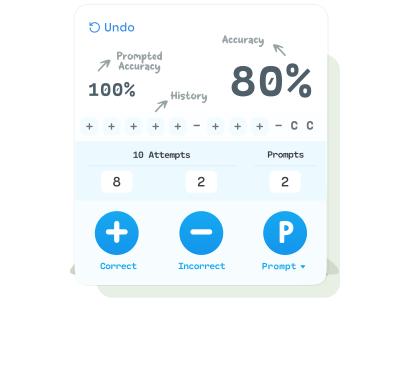
Collect simple, meaningful data to guide instruction. Rather than counting every occurrence of dysregulation, track:
- Whether the student used the targeted strategy
- The context of use (setting, people present)
- Level of independence
- Perceived effectiveness
Over time, patterns emerge. You might find a strategy works well in calm group work but fails during transitions, and that’s where coaching time should focus next.
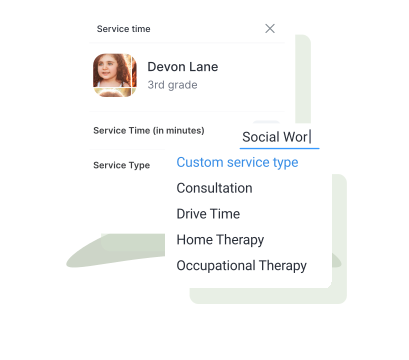
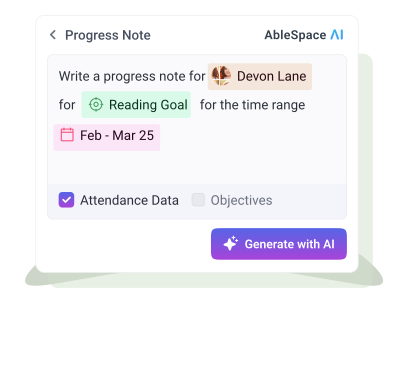
This level of tracking becomes far more manageable when observations and notes can be logged directly within a student’s IEP goal. Instead of juggling separate data sheets or scattered anecdotal records, staff can document strategy use, context, and independence in one centralized space. When that documentation is visible to the broader team, as it is in AbleSpace, patterns across settings, staff, and time become easier to identify and respond to instructionally.
8. Align Caregivers and Staff Around Shared Strategies
Generalization thrives on consistency. When families and staff share language and strategy cues, students encounter the same expectations across environments, not parallel systems that compete with each other.
Send home the same continuum of cues, visuals, or emotion vocabulary you use at school. A shared “strategy map” makes it more likely a student will recognize a challenge and choose a coping response at home, in the community, or on the playground.
Final Thought
Coping skills aren’t boxes to tick; they’re networks of awareness, choice, and response that must be deliberately woven into the fabric of daily life. When instruction bridges contexts, people, and triggers, and when students are coached to see themselves as active agents of their regulation, coping becomes not just learnable, but portable.
And that’s the kind of change that lasts.