IEP meetings capture milestones. Progress reports summarize growth. Quarterly updates chart movement.
What they don’t capture is the unstable phase between benchmarks.
That’s where students hover, partially independent, partially prompted. Sometimes regulated, sometimes overwhelmed. Sometimes transferring skills, sometimes starting over in a new setting.
Most of special education unfolds in that daily instructional phase. The decisions made there determine whether a student consolidates a skill or plateaus in it.
This is not about rewriting goals. It is about refining what happens between them.
Here are a few strategies that make that phase instructional, not incidental.
1. Design for Cognitive Load Before Teaching Content
Many students in SPED settings are not failing to learn content; they are overloading on task structure.
Working memory is finite. When directions, materials, transitions, and performance expectations compete simultaneously, content becomes inaccessible even if the skill itself is within reach.
What this looks like in practice:
- Pre-highlight only the relevant section of a worksheet rather than handing over the full page
- Deliver directions in two steps maximum before requiring a response
- Keep visual supports stable across days instead of redesigning them each lesson
- Reduce physical material clutter on desks before instruction begins
When the cognitive bandwidth required to start decreases, initiation improves. When initiation improves, data becomes more reflective of skill rather than overwhelm.
What changes when done well:
The same student who appeared avoidant begins responding faster. Prompt levels decrease without additional reinforcement systems. Task refusal drops not because behavior was targeted, but because overload was removed.
2. Track Prompt Dependency, Not Just Accuracy
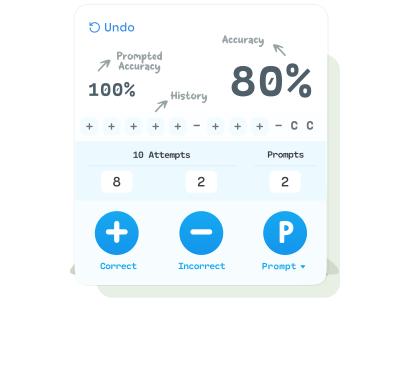
Accuracy percentages rarely tell the full story. A student scoring 80% with full verbal prompting is in a very different place than one scoring 60% independently.
Prompt dependency is often the hidden variable behind stagnant progress.
Instructional shift:
- Document the highest level of prompt required per response (independent, gestural, verbal, model, physical)
- Graph prompt fading alongside accuracy trends
- Set instructional decisions around independence progression, not just correct answers
This matters because independence predicts generalization. A skill mastered only under adult mediation does not travel well across settings.
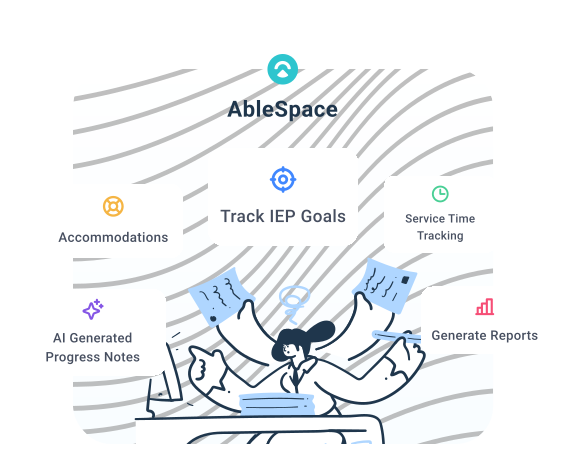
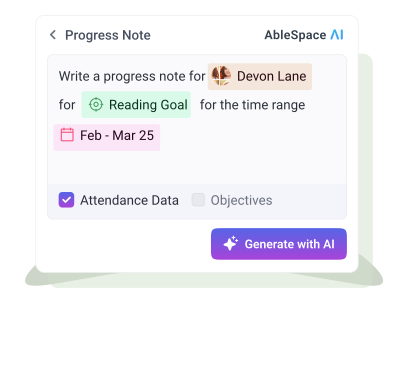
When prompt levels and context are logged directly within a student’s goal documentation instead of being scattered across separate sheets, instructional patterns become visible faster. Platforms built for centralized IEP goal tracking and cross-provider visibility, including AbleSpace, make it easier to notice when a student performs independently in speech but remains verbally prompted in the classroom.
What changes when done well:
Prompt fading becomes intentional rather than reactive. Staff calibrate supports instead of defaulting to the most helpful cue. Students begin initiating without waiting for adult signals.
3. Teach Regulation at the Point of Escalation, Not in Isolation
Coping strategies taught during calm moments rarely transfer automatically to dysregulated ones. The nervous system does not retrieve skills it has not practiced under similar conditions.
Instead of reserving regulation instruction for designated “calm down” lessons, embed it inside mild friction.
Example:
- During a slightly challenging transition, pause and coach a single breath before moving
- When frustration first appears (not after escalation), label it and rehearse a micro-strategy
- Keep the demand present while slightly modifying its intensity
The key principle: regulation must coexist with demand. Removing all expectations during dysregulation can unintentionally reinforce avoidance. Conversely, escalating demands without co-regulation increases defensive behavior.
What changes when done well:
Students begin using strategies earlier in the escalation curve. Recovery time shortens. Staff responses become consistent across providers because regulation coaching is tied to predictable triggers rather than personality styles.
4. Build Instruction Around Transition Points
Most instructional loss in SPED classrooms does not occur during lessons. It occurs during transitions.
Transitions tax executive functioning: shifting attention, organizing materials, processing new expectations. For students with executive functioning challenges, these moments are neurologically expensive.
Rather than treating transitions as neutral space, design them as instructional events.
Strategic adjustments:
- Post a consistent visual cue that previews the next demand
- Use a brief, scripted language pattern before every shift
- Allow 30 seconds of structured preview before entering a new task
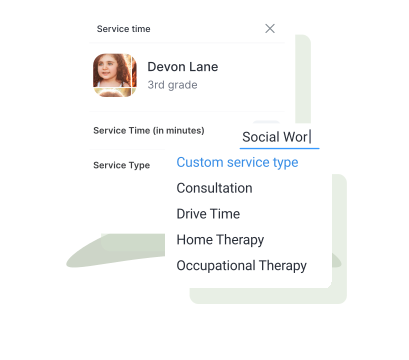
Tip: When classrooms operate on rotating schedules, especially across service providers, predictability becomes more complex. Platforms that allow administrators to implement and update rotating schedules across provider calendars, such as AbleSpace, reduce friction for students who rely heavily on routine stability.
What changes when done well:
Behavior incidents decrease without direct behavior plans. Instructional minutes increase. Students arrive at new tasks neurologically prepared instead of cognitively scrambled.
5. Make Data Instructional Within the Same Week
If progress monitoring does not alter instruction within the same week, it functions as documentation rather than feedback.
To make data usable:
- Review patterns at the end of each teaching block
- Adjust prompt level or task format in the next lesson, not the next month
- Identify one micro-variable to test (timing, modality, grouping)
Short feedback loops protect against plateau. They also prevent teams from attributing stagnation to student capacity rather than instructional design.
What changes when done well:
IEP goals feel dynamic. Staff meetings shift from explaining why growth hasn’t occurred to analyzing what variable shifted it. Instruction becomes experimental in the best sense: responsive, precise, iterative.
Final Word
Students in SPED settings notice instructional inconsistency faster than adults realize. They track who rescues, who waits, who overprompts. Strategy is not only about tools, it is about predictability in adult response. When staff behavior stabilizes, student behavior follows. Instructional coherence becomes the quiet architecture holding everything else in place.