The Case of the Vanishing Minutes
During a mid-year audit, a middle-school special educator, let’s call her Dana, opened a log that was supposed to reflect 240 minutes of weekly reading intervention for a student named J. Instead, the numbers showed 165.
Not a student absence issue. Not a teacher absence issue. The minutes simply slipped away in tiny increments: a fire drill here, a last-minute schedule change there, a homeroom extension, a bus-duty request, a forgotten entry, a service delivered informally but never logged.
No single moment looked serious. But together? They amounted to nearly 30% of J’s support disappearing. And the real consequence wasn’t an audit finding, it was the student who never got special education services that had been specifically written into their IEP as necessary for progress.
Invisible minutes aren’t rare. They’re systemic.
Why Service Minutes Disappear (Even in Well-Run Programs)
The disappearance of minutes isn’t a failure of commitment, it’s a failure of structure. And there are patterns that show up across districts:
1. The “Micro-Interruption Spiral”
Most missing minutes aren’t big emergencies. They’re small interruptions that aren’t recorded because each one feels too insignificant. But IEP service minutes rely on cumulative time. Ten small disruptions equal a full session lost.
2. The Misalignment Between IEP Language and Scheduling Reality
IEPs are often written with formulaic minute allocations (e.g., “240 minutes/month”), but school bell schedules rarely divide so neatly. This misalignment creates natural “minute drift,” especially when multiple providers share a student.
3. Pull-Out vs. Push-In Conflicts
When a student is scheduled for reading intervention during a science lab, teams often choose the high-stakes class and quietly skip the minute. Over time, this becomes a habit, not a conscious decision.
4. Informal Service Delivery That Never Gets Logged
A teacher checks in with a student between classes, reteaches a skill during lunch, or provides a quick prompt during group work. It is a service, but if the system isn’t designed to capture it, it never makes it into the IEP documentation.
5. Multi-Provider Blindness
Speech, OT, PT, resource teachers, and paras often assume another provider “made up the minutes.” Without real-time visibility, shared students accumulate hidden deficits.
The root issue is fragmented perspective; each provider sees only their own window of the day. Small gaps that seem insignificant individually become meaningful losses when viewed across all services.
Invisible minutes thrive in those unseen spaces.
The Consequences No One Likes to Talk About
Most educators think first about compliance when they hear “missing minutes.” And yes, compliance matters. But it’s not the heart of the issue.
1. Students Lose Skill Momentum
Service time is written into an IEP for a reason. Missed minutes mean slower academic growth and weaker generalization of skills.
2. Progress Monitoring Becomes Unreliable
If a student shows “no progress,” it’s impossible to know whether the instruction didn’t work or the minutes simply weren’t delivered.
3. Families Lose Trust
Few conversations feel worse than explaining to a parent that the minutes they believed were delivered actually weren’t.
4. Staff Burnout Increases
Educators become exhausted when they must retro-log, justify missed minutes, or reconstruct months of special education data with incomplete records.
5. District Accountability Risks Grow
Missed minutes can trigger corrective action plans, targeted monitoring, and required compensatory services.
Minute loss isn’t harmless. It’s cumulative harm.
How Minutes Actually Get Lost: A Closer Look
Schools often search for a single cause, but invisible minutes accumulate through structural design flaws:
• Time That Isn’t Owned by Anyone
When no one owns the minute, whether it's the teacher, para, or specialist, everyone assumes someone else is covering it.
• Calendars That Can’t Talk to Each Other
Providers use different tools: spreadsheets, whiteboards, personal planners, shared documents, the SIS calendar. Without a unified system, discrepancies multiply.
• Staff Shortages and “Coverage Creep”
When a para is pulled unexpectedly to cover another classroom, their service minutes evaporate silently.
• Overstuffed Bell Schedules
Some schools schedule interventions in five-minute windows that leave no space for transitions. Those minutes are functionally impossible to deliver.
• Service Minutes Written at the Wrong Level of Granularity
Minutes written vaguely (e.g., “as needed,” “ongoing support,” “regular check-ins”) are the ones most likely to disappear.
Understanding the root mechanics of minute loss is the first step toward fixing it.
What Actually Works: Capturing 100% of Service Minutes Without Burning Out Staff
Here’s what districts with strong service-delivery fidelity do differently:
1. Translate the IEP Into a “Minute Map”
A minute map is a visual breakdown of:
- service type
- exact number of minutes per week/month
- provider
- location
- delivery model
- non-negotiable time blocks
This eliminates ambiguity. A “minute” becomes a concrete, schedulable object, not an abstract requirement.
2. Schedule Services Backwards
Instead of fitting services around the general schedule, build the schedule by starting with IEP-mandated minutes.
Schools that reverse this order experience dramatically fewer conflicts.
IEP minutes are legally required; electives and flexible blocks are not.
3. Build a 3-Window Rule for Service Delivery
Districts that successfully capture minutes tend to follow a pattern:
- Window A: Primary delivery time
- Window B: Backup time in the same week
- Window C: Make-up window
This prevents minute loss due to unavoidable disruptions (assemblies, drills, assessments, student absences).
4. Use a Single Logging System
When everyone logs differently, reconciliation becomes guesswork.
When everyone logs in the same place, patterns become visible instantly.
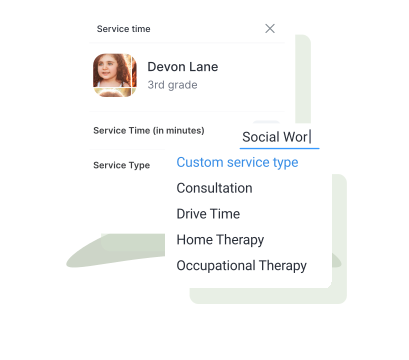
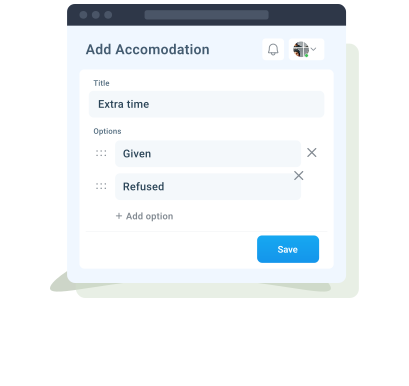
This is where many schools adopt digital systems: tools that let staff log services in real time, surface discrepancies, and show administrators where minute drift is emerging. Platforms designed for special education workflows, like AbleSpace, centralize schedules, service logs, and provider data so the “invisible minute” becomes visible the moment it starts slipping.
The key is not the software itself, it’s the shared visibility that leads to earlier correction.

5. Track Minutes Weekly, Not Monthly
Monthly reporting hides patterns. Weekly tracking exposes them.
When a provider logs 50 required minutes but only delivers 35, the discrepancy is addressed within days, not after a quarter has passed.
6. Adopt an “Escalation Ladder” for Minute Drift
High-functioning teams use a simple protocol:
- If a student misses 10% of minutes in a week → team conversation
- 20% → schedule adjustment
- 30% → IEP team review and intervention
This keeps teams proactive instead of reactive.
7. Audit Your Own Schedules Every 6 Weeks
Self-audits catch the early signs of chronic drift.
Teams check:
- Were any minutes consistently missed?
- Were substitutes trained to deliver services?
- Did any provider’s caseload become unmanageable?
- Were changes in the gen-ed schedule reflected immediately in service maps?
Internal audits reduce the surprise factor when state monitoring arrives.
8. Teach Staff to Log Informal Support (Accurately)
Support during lunch, hallway reteaching, or brief in-class prompting may count as service minutes if the IEP describes it that way.
Teams should:
- Define what counts as “service”
- Distinguish it from general classroom support
- Log it consistently
Clarity protects both students and providers.
Why This Matters More Than Ever
Special education is increasingly data-driven. Service delivery is no longer just a compliance requirement, it’s a measure of instructional integrity.
Students rely on consistent, documented support to close gaps. Teams rely on accurate data to know what’s working. And districts rely on service fidelity to ensure legal and instructional equity.
The invisible service minute is one of the fastest ways a strong program can quietly slide into inconsistency.
But it’s also one of the easiest problems to fix once it becomes visible.
FAQs
1. What counts as a “service minute,” really?
A service minute isn’t just time spent in a pull-out group, it’s any instructional or support activity directly tied to the IEP, delivered intentionally and in alignment with the student’s goals. It’s not the same as casual help or general classroom support. If the action advances an IEP goal and is delivered by the designated provider, it counts. The clearer teams are on this definition, the fewer minutes fall through the cracks.
2. Should schools give compensatory services when minutes are missed?
In most cases, yes. If students didn’t receive services written into their IEPs, compensatory time is required to help them regain progress. The amount isn’t always minute-for-minute; it’s based on the impact of the loss. The sooner teams identify missed services, the easier it is to provide meaningful make-up support. Documenting both the missed minutes and the catch-up plan protects the student and the team.
3. Can too many people providing services actually reduce a student’s overall support?
Yes, when multiple providers work with a student without coordinated planning, services can unintentionally overlap, duplicate, or even cancel each other out. This creates support “noise” rather than support clarity. Coordinated scheduling often increases the impact of each minute, even if the total minute count stays the same.