There’s a specific moment every special educator knows.
You’re in a meeting. You’ve explained the goal. You’ve shown the data. You’ve been careful with your words.
And still, a parent says something like:
“So… is this good? I honestly can’t tell.”
That moment isn’t about vocabulary. It’s about misaligned mental models.
You are thinking in systems, constraints, skill acquisition, generalization, and instructional trade-offs.
Parents, meanwhile, are listening for something else entirely:
“Is my child doing okay relative to what their life actually looks like?”
Clear IEP communication starts when you stop assuming you’re explaining progress on the same axis.
The mistake: reporting progress as if parents experience school the way you do
Educators live inside data streams. Parents live inside stories.
When you say:
- “Prompting has decreased”
- “Accuracy is inconsistent”
- “Generalization is emerging”
Parents don’t map that onto instruction. They map it onto home.
They’re silently wondering:
- “Why does homework still take an hour?”
- “Why can’t they do this at the grocery store?”
- “Why does it work with you but not with us?”
If you don’t explicitly connect school progress to those lived questions, parents assume the data is disconnected from reality.
A better anchor: explain progress in terms of instructional cost
One of the most useful reframes you can give parents is this:
“Progress isn’t just about what your child can do, it’s about how much effort, structure, and adult support it takes to get there.”
This is not common sense to families.
For example:
- “Your child still needs help starting tasks, but the help is lighter and shorter.”
- “They’re making the same errors, but they recover faster.”
- “The skill isn’t independent yet, but it no longer collapses under stress.”
This helps parents understand why a goal might stay the same on paper while the workload underneath it has changed dramatically.
Use contrast, not averages
Averages blur reality. Parents understand contrast.
Instead of:
“Accuracy improved from 50% to 70%.”
Try:
“At the start of the year, your child needed reminders every 30 seconds to stay with the task. Now, they can work for five minutes before support is needed.”
That contrast tells a story of regulation, stamina, and learning readiness; things parents feel at home but rarely see acknowledged in IEPs.
Name the decisions parents never see
One of the most trust-building things you can say is this:
“Some of the most important progress happens before the skill shows up on paper.”
Then explain that progress isn’t just about output, it’s about choice points.
What families don’t see are the moments when a student:
- Pauses instead of escaping
- Tries a strategy before asking for help
- Re-enters a task after making an error
- Waits through confusion instead of shutting down
These aren’t smaller versions of academic skills. They’re the conditions that make learning possible. When parents understand that their child is making different decisions under pressure, they stop equating progress solely with correct answers.
Be honest about why progress doesn’t generalize yet
This is where many educators get vague to avoid conflict. Vagueness creates more conflict.
Instead of:
“We’re still working on generalization.”
Say:
“Right now, the skill depends on predictability. At school, the environment is structured to support that. At home, the variables are different, so the skill hasn’t stabilized there yet.”
This shifts the conversation from why isn’t my child doing this to what conditions does this skill require.
That distinction matters.
Use data to explain decisions, not justify outcomes
Parents often feel data is being used to defend the system rather than guide instruction.
Flip the function of data in your explanation:
- “The data showed us this approach wasn’t efficient, so we changed it.”
- “The pattern told us we were asking for independence too soon.”
- “The trend helped us realize the goal was too broad.”
When families hear that data changes what you do, it stops sounding like a verdict.
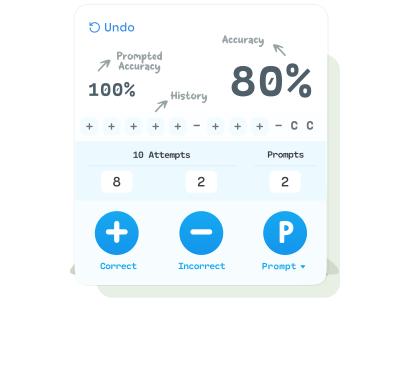
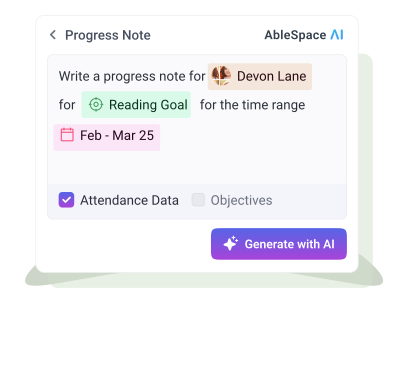
Tools like AbleSpace help make that shift visible because they don’t just store data, they organize it around instructional moves. When you can pull up six weeks of daily logs and show, “This is when we reduced prompts, this is when errors spiked, and this is why we reintroduced support,” the data sounds less like justification and more like professional judgment. Parents aren’t reacting to numbers anymore; they’re seeing cause and effect.
End by aligning on expectations, not optimism
Avoid ending with “We’re hopeful” or “We’ll keep working.”
End with shared clarity:
- What progress should look like next
- What would be concerning
- What’s intentionally being deprioritized (yes, say this)
For example:
“Right now, independence in new environments isn’t the target. Stability is. Once that’s reliable, we’ll shift.”
Parents don’t need reassurance as much as they need orientation.
The real shift
Clear IEP communication isn’t about sounding simpler.
It’s about making your professional judgment visible.
When parents can see how you think, not just what the numbers say, they stop asking whether progress is real.
They already know the answer.
FAQs
1) What if a parent wants certainty and I only have probabilities?
Be clear about what the data can and cannot promise. Framing progress as increasing likelihood rather than guaranteed outcomes respects both the science and the family’s need for honesty.
2) What if parents compare this year’s progress to last year’s and think it’s slower?
Re-anchor the conversation to task complexity and independence, not just rate. Growth often slows when expectations rise, even though the skill demand is actually higher.
3) How do I talk about progress when supports are still heavy?
Separate skill acquisition from support dependence. A student can be learning efficiently while still requiring structure, and saying that explicitly prevents support from being mistaken for failure.