The request doesn’t come during a calm week. It lands in the middle of everything else.
“Please submit updated progress data for review.”
You navigate to the IEP record and scan the progress log. One goal shows consistent tracking. Another has a two-month silence. A related service log confirms minutes delivered, but there’s no measurable growth recorded. Nothing is technically wrong, but nothing is fully defensible either.
The problem isn’t that services weren’t provided. It’s that the documentation trail thinned out just enough to create doubt.
And once doubt enters the file, it spreads.
The solution isn’t scrapping the log and rebuilding from scratch. It’s stabilizing what exists and repairing it strategically.
Here are seven ways to restore incomplete IEP data and progress logs, without resetting the entire record.
1. Stop Thinking in Terms of “Missing Data.” Think in Terms of “Recoverable Evidence.”
An incomplete log doesn’t always mean missing instruction. It often means missing captured evidence.
Before recreating anything, audit what already exists across:
- Service provider session notes
- Communication logs
- Draft worksheets or work samples
- Related service billing entries
- Email summaries to parents
- Behavior tracking sheets
- Assessment probes that were administered but never logged formally
Many teams underestimate how much usable evidence already exists in adjacent systems.
When reconstructing, avoid retroactively inventing percentages. Instead:
- Document the date of instruction.
- Attach or reference the artifact (work sample, probe, rubric).
- Record observable performance tied to the goal condition.
2. Patch Gaps Forward, Not Backward
The biggest mistake in fixing logs is trying to backfill months of data evenly. That invites estimation, which creates risk.
Instead, apply a “stabilize and resume” approach:
- Identify the last verifiable data point.
- Resume consistent tracking immediately.
- Document the gap transparently if necessary (“Progress monitoring paused due to staffing change from Oct 12–Nov 3; monitoring resumed Nov 6.”).
Auditors and administrators respond better to clear explanation than artificially smooth data trends.
3. Convert Qualitative Notes into Quantifiable Data (Carefully)
Many incomplete logs contain rich qualitative notes:
“Completed a 4-step task with less adult support than last month.”
“Transitioned from math to reading with only one verbal cue.”
“Stayed engaged for most of the small-group activity after initial prompting.”
Those statements feel helpful, but they are not entirely measurable. Instead of discarding them, convert them using observable indicators:
- “Less adult support” → Document the exact number and type of prompts provided.
- “One verbal cue” → Track cue frequency across multiple sessions to establish a pattern.
- “Stayed engaged for most of the activity” → Define duration (e.g., 12 of 15 minutes on-task).
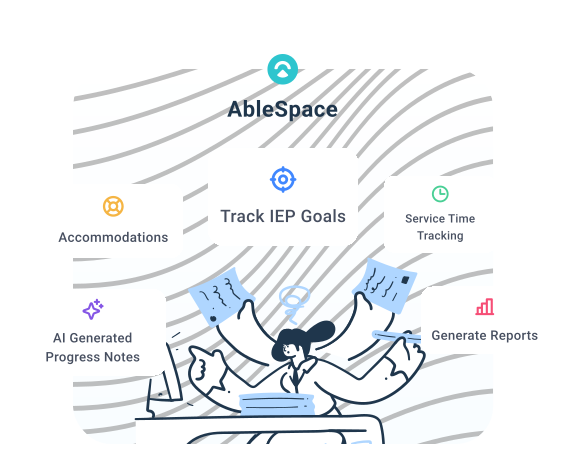
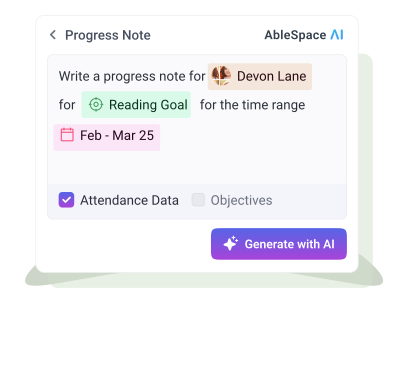
Tip: Systems like AbleSpace help reduce ambiguity by structuring AI-generated progress notes around the exact condition, skill, and criteria written into the IEP goal. Because entries are anchored to goal components rather than open-ended narration, vague phrasing is less likely to slip through.
4. Separate Service Delivery Compliance from Goal Progress Compliance
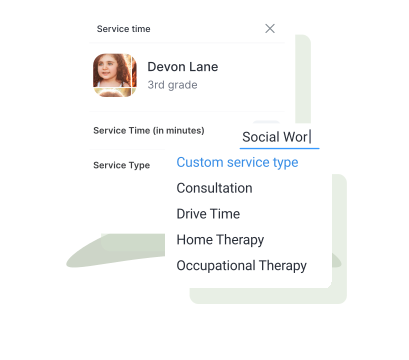
A common documentation trap: minutes are logged perfectly, but goal progress isn’t.
These are distinct compliance categories:
- Service compliance → Were minutes delivered as required?
- Progress compliance → Was measurable growth tracked and reported?
If service minutes are intact, the compliance exposure is narrower than it feels. The risk shifts from “failure to implement” to “insufficient evidence of impact.” Those are not treated the same in audits or dispute contexts.
When correcting the issue, avoid treating it like a service lapse. Instead:
- Preserve clean service records exactly as they are.
- Insert a dated entry clarifying the evidence currently being used to determine performance.
- In the next progress report, describe the present level of performance without asserting growth rate during the undocumented period.
5. Address the Behavioral Cause of Documentation Gaps
Incomplete logs are rarely a knowledge problem. They’re a workflow psychology problem.
Patterns that commonly cause gaps:
- Waiting for “perfect” data before logging.
- Saving entries for the end of the week.
- Tracking on paper with intent to transfer later.
- Avoiding logging during difficult weeks when progress feels stagnant.
Perfectionism is particularly dangerous. Data collection should reflect reality, including plateaus.
A stabilizing habit that works:
- Log immediately after sessions, even if brief.
- Record what happened, not what “should have” happened.
- Treat data entry as part of service delivery, not an administrative add-on.
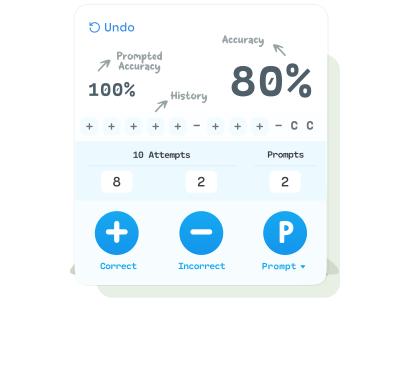
In tools such as AbleSpace, goal tracking and progress entry exist within the same workflow used to plan services. Providers don’t leave one system to update another. Data is captured while details are still accurate, reducing the accumulation of partial or delayed entries.
6. Use Trend Lines, Not Isolated Points
When repairing incomplete logs, resist the urge to interpret progress from sparse data. Instead:
- Collect 3–4 consistent new data points.
- Establish a clear baseline trend.
- Use that trend in your next progress report narrative.
A short, recent, consistent trend is stronger than scattered historical entries.
If historical gaps are significant, document:
“Due to inconsistent monitoring earlier in the reporting period, current progress determination is based on data collected from [date range].”
This protects defensibility without overstating certainty.
7. Don’t Rewrite. Clarify.
The instinct to delete incomplete entries and start fresh creates audit risk. Altering timestamps or replacing logs can be problematic.
Instead:
- Add supplemental entries.
- Clarify context in comments.
- Attach artifacts.
- Resume consistent monitoring.
Conclusion
Repairing logs once is manageable. Repeating the cycle is exhausting.
To prevent recurrence:
- Schedule recurring progress monitoring blocks on the calendar.
- Align collection frequency with reporting deadlines.
- Use structured goal-tracking systems that flag inactivity.
- Keep all documentation within a single workflow environment rather than scattered tools.
Documentation always feels manageable today. The risk appears when a student transfers, a complaint is filed, or a due process request surfaces months later. A forward-protection plan isn’t about neat logs, it’s about making sure the record speaks for itself when the people involved no longer can.