Special education is one of the few professions where people are judged on decisions they were never trained to make.
No certification covers how to act when guidance updates halfway through implementation.
No framework explains what to do when a student outgrows a support before paperwork allows it.
No protocol addresses how often educators are forced to choose between being technically correct and instructionally honest.
Yet these decisions happen daily, quietly, and without shared rules.
Most breakdowns in special education don’t happen because educators make poor choices. They happen because the work now requires a category of judgment the system refuses to acknowledge.
This blog names that gap, and shows how some classrooms are already operating beyond it.
Why the Same Decisions Keep Interrupting Instruction
Ask where time actually disappears during the day.
It’s not instruction.
It’s having to stop and rethink things that were already decided once.
- How to phrase a goal before an IEP meeting because guidance shifted again.
- Whether a visual support still applies now that the schedule changed.
- How to explain the same accommodation to a new paraprofessional on a busy morning.
None of these are new problems. They reappear because the original decision lived only in someone’s head. When conditions change, the reasoning disappears, and the decision has to be rebuilt on the fly.
Re-decision is invisible labor. It shows up as hesitation, second-guessing, and extra minutes added to tasks that used to feel automatic.
The fix is not working faster.
If a decision keeps interrupting instruction, it should be written so it doesn’t have to be rethought.
Agile teams leave short, usable traces of decisions where the work happens, so teachers aren’t reconstructing logic mid-lesson.
What Happens When Systems Assume the Year Will Hold Still
Most SpEd structures quietly assume September logic still applies in February.
That assumption collapses every year.
Students grow, regress, mask, unmask, generalize, or lose skills. Staffing changes. Schedules fragment. Regulations clarify just enough to create new ambiguity. Supports that worked under calm conditions fail under cognitive load.
None of this is an exception. It is the expected trajectory.
Yet IEPs, training cycles, and tool adoption are still designed as if stability exists. That mismatch creates lag — and lag creates compliance pressure, instructional drift, and exhaustion.
Agile practice starts with a different premise:
If something must survive the school year, it has to survive misalignment.
That means designing supports, goals, and tools that tolerate disruption without collapsing.
Stop Optimizing for the IEP
The IEP is not where the work happens. It is where the work is recorded.
When systems optimize for documentation instead of daily decisions, educators end up maintaining paperwork that no longer reflects reality.
Effective teams quietly flip the priority:
- Stabilize daily decision-making first
- Let documentation trail reality instead of freezing it
- Update formally once the new pattern proves durable
This is not noncompliance. It is realism.
One practical move: Write goals that describe decision boundaries instead of narrow behaviors. Goals that survive regulatory tweaks don’t need constant rewriting because they describe what guides instruction, not just what gets measured.
How Professional Learning Misses the Moment of Use
Formal professional development arrives too late to be useful. By the time training is scheduled, educators have already improvised workarounds.
What actually helps is permission to learn in fragments, tied to live problems.
- Five minutes to confirm how a change affects wording before a meeting.
- A quick reference when introducing a support under real classroom conditions.
- Contextual reminders that appear at the moment of use, not during a workshop.
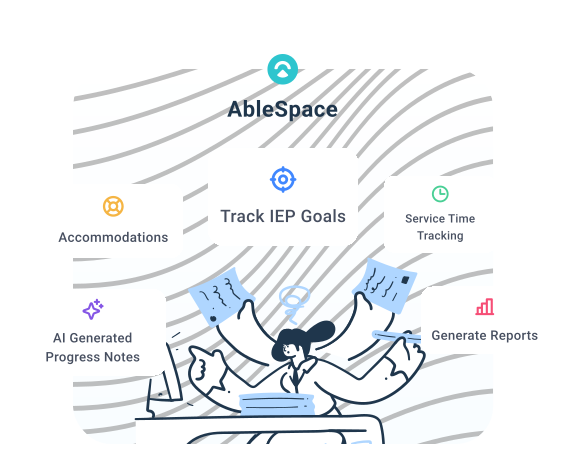
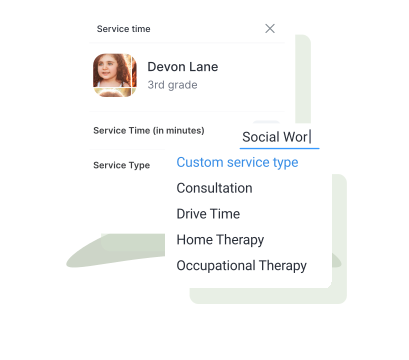
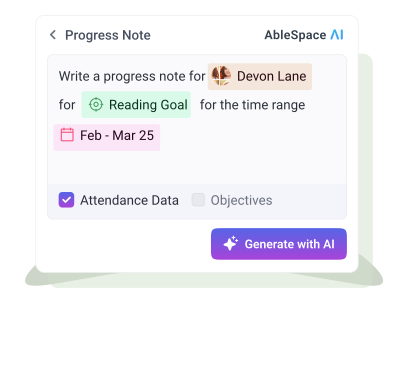
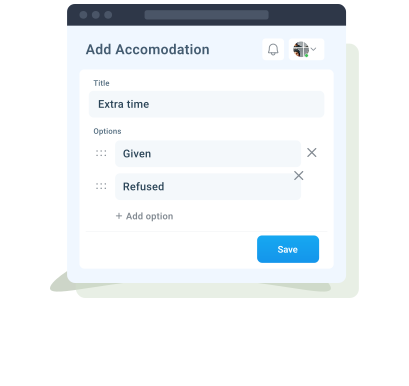
This is why some teams gravitate toward AbleSpace without making a big deal of it. Not because it is “innovative,” but because it puts student-specific supports, access needs, and usage context in one place, so educators aren’t hunting through notes, emails, or memory. When a change hits, the reference is already there. Learning happens inside the workflow instead of on top of it.
That’s how lag shrinks.
Technology Should Be Judged by Failure, Not Features
A simple test most teams skip:
What happens to this support on the worst day of the week?
When routines break.
When staffing is thin.
When cognitive load spikes.
If a student abandons a tool under pressure, the tool was never actually supporting independence. If adults have to prompt its use, it’s adding friction.
Agile adoption starts by watching what fails first. The best tools are not the most powerful. They are the ones students reach for without being reminded.
Sometimes the right move is subtraction. Fewer tools. Fewer steps. Clearer access.
Meeting Only Where the System Starts to Fray
Collaboration breaks when it’s built around updates instead of failure points.
Agile teams don’t meet to review everything. They meet when something stops holding.
- A student needing constant adult prompting for a support meant to build independence.
- Data showing “progress” while day-to-day access quietly erodes.
- A plan that technically complies but only works under ideal staffing conditions.
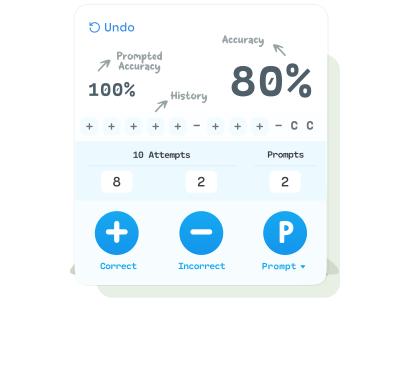
The work is identifying where reality diverges, fixing that one break, and moving on.Shared visibility matters more than shared meetings. When educators, therapists, and aides can see the same real-time picture of which supports students use independently and where breakdowns occur, decisions stick. AbleSpace creates that shared view, eliminating second-hand reporting and misaligned interpretations.
Conclusion
The real marker of an effective SpEd system is not how it performs on calm days, but how little it asks of educators when things go off-script. If a classroom still works when plans break, staff change, and students shift, it’s doing its job. That’s not resilience. That’s design.
FAQs
1) How can teams tell whether a tool is helping students or just helping adults feel organized?
Adult efficiency improves first; student independence should follow. If organization increases but student initiation doesn’t, the tool is likely serving workflow more than access. The key question is whether the student’s behavior changes when adults step back.
2) How do you introduce new supports mid-year without destabilizing routines?
New supports land best when framed as replacements, not additions. Students tolerate change more easily when something else quietly disappears at the same time. Stability isn’t about sameness; it’s about keeping the total cognitive load steady.
3) When is “more training” actually the wrong response?
When errors repeat in predictable moments, not across skill levels. If breakdowns happen during transitions, substitutions, or schedule changes, the issue is environmental, not instructional. Redesign the moment itself by simplifying steps, reducing handoffs, or embedding the support directly into the routine. Training won’t fix what only redesign can.