
A student pauses at the doorway, backpack still on, scanning the room as if something usually happens next. The morning routine has been taught for months. The visual schedule is posted. The class is already seated.
An adult tilts their head toward the storage area.
The student walks over and begins unpacking.
Was that a cue? A prompt? A gesture of support, or an instructional dependency quietly reinforced?
In busy classrooms and therapy spaces, these distinctions blur quickly. The language gets used interchangeably. Yet the difference between a cue and a prompt, and between gestural and physical support, carries real consequences for independence, dignity, and data integrity.
This is not wordplay. It is the difference between support and substitution.
Prompts vs. Cues: Control of the Behavior
At the most fundamental level, the difference lies in what controls the response.
A cue is part of the natural stimulus environment. It signals what to do but does not artificially modify the response conditions. Cues are embedded in routines: the bell rings, materials are placed on desks, a visual schedule indicates the next activity. Ideally, cues are the long-term controllers of behavior.
A prompt, by contrast, is an additional antecedent stimulus deliberately introduced to increase the likelihood of a correct response. Prompts are temporary supports layered onto the environment. They are not meant to remain.
When a student only responds after an adult says, “What do you do next?” the question is functioning as a prompt. When the student responds because the posted checklist signals the next step, the checklist is functioning as a cue.
The risk emerges when prompts masquerade as cues. A verbal reminder delivered daily for six months is no longer temporary support. It has become the controlling stimulus.
For experienced practitioners, the diagnostic question is simple:
If the added support were removed tomorrow, would the target response still occur?
If not, the behavior is prompt-dependent.
Gestural vs. Physical Support: Degrees of Intrusion
Within prompting hierarchies, both gestural and physical prompts fall along a range of intrusiveness, but they are not interchangeable.
Gestural Prompts
Gestural prompts involve movements such as pointing, nodding, tapping, or looking toward the relevant stimulus. They direct attention without making contact.
Gestural support:
- Preserves bodily autonomy.
- Allows space for initiation.
- Often functions as a mid-level prompt in least-to-most hierarchies.
- Can be faded by reducing amplitude, proximity, or duration.
Because gestural prompts rely on the learner’s ability to discriminate the gesture, they are less intrusive but still clearly supplemental. Overuse, however, can create subtle dependency. Students may begin scanning adults instead of materials.
Physical Prompts
Physical prompts involve contact with the learner’s body to guide movement. These range from partial physical guidance (light touch at the elbow) to full physical assistance (hand-over-hand).
Physical prompting:
- Provides high response reliability.
- Is often used during skill acquisition or when safety is a concern.
- Carries significant ethical responsibility.
In contemporary practice, full hand-over-hand prompting is approached with caution, particularly with older students. It can suppress initiation, reduce opportunities for error correction, and raise consent considerations. Physical prompting must be intentional, minimal, and systematically faded.
Importantly, physical support is not inherently problematic. Unplanned physical prompting is.
The Hidden Cost of Blurred Categories
When cues and prompts are lumped together, two problems emerge.
First, independence is misjudged. A data sheet may show “independent transitions” when, in reality, a quiet pointing gesture preceded every movement. The independence is conditional.
Second, fading stalls. Prompts that are not identified as such rarely receive fading plans. They persist because they are efficient.
Over time, classrooms drift into what might be called prompt culture, a setting where adult behavior, not environmental design, governs student responding.
Fading with Precision
Effective fading is systematic, not intuitive. It may involve:
- Moving from most-to-least physical assistance.
- Transitioning from physical to gestural, then to natural cues.
- Introducing time delay before delivering a prompt.
- Reducing the noticeability of gestures.
- Shifting from adult-delivered prompts to environmental supports.
Every prompt should be designed to make itself unnecessary.
Ethical Considerations in Physical Prompting
Physical support should never be automatic. It should be justified by instructional need or safety, not efficiency.
Questions worth asking:
- Is the learner aware of and comfortable with physical guidance?
- Has less intrusive support been attempted?
- Is the physical prompt truly necessary, or simply faster?
- Is there a documented plan to fade?
For students with histories of trauma or sensory defensiveness, physical prompting can have unintended emotional impact. Ethical practice demands sensitivity to context, not rigid adherence to hierarchy charts.
Data Integrity and Staff Consistency
If one staff member records a pointing gesture as “independent” and another records it as “gestural prompt,” progress data will diverge. Teams may believe fading is occurring when support levels have remained static.
Clear operational definitions matter. So does shared tracking.
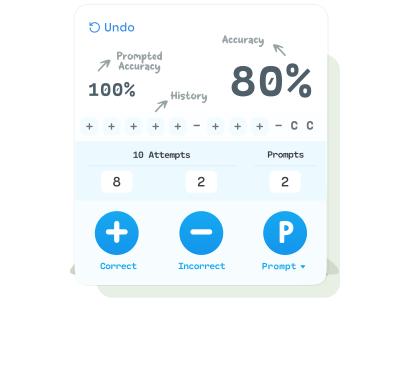
Tip: When prompt levels are captured alongside accuracy and frequency metrics in a centralized goal-tracking platform, educators gain clarity about whether a student’s responding is cue-driven or prompt-dependent, an insight that paper sheets rarely reveal but tools like AbleSpace can surface instantly.
Practical Shifts for Tomorrow
Consider these reflective adjustments:
- Audit one routine for hidden prompts masquerading as cues.
- Define, in writing, what counts as independent responding for a specific goal.
- Identify one skill where gestural prompts could replace physical support.
- Build a fading criterion into data collection before prompt dependency solidifies.
Before introducing any new intervention, examine the ones already in place. Many plateaus are not skill deficits but support patterns that never evolved. Refining the quality of assistance often produces more growth than adding another strategy.