A new IEP rarely arrives at a convenient moment. It shows up between classes, during coverage, or buried in an inbox already too full. There is usually an expectation, spoken or not, that it can be “reviewed quickly” before instruction begins. But experienced educators know that this document will quietly shape far more than paperwork. It will influence daily decisions, data habits, service coordination, and how much explaining happens later in the year.
Reading a new IEP is less about understanding what was decided and more about assessing how those decisions will play out during actual instruction.
Notice how the IEP functions beneath the wording
Every IEP is a snapshot of a system mid-motion. It reflects timelines, staffing constraints, parent priorities, district language, and prior team dynamics. A useful first read focuses less on phrasing and more on function.
Pay attention to:
- Which needs are named directly and which are softened or implied
- Where the language is specific and where it becomes carefully broad
- Whether goals reflect day-to-day instruction or only annual reporting needs
This lens helps separate what must be implemented from what will require interpretation before it reaches the classroom.
Goals reveal more than progress measures
Goals are often read as endpoints. In practice, they reveal expectations about time, staffing, and instructional feasibility. A goal can be technically appropriate and still be misaligned with how learning actually happens day to day.
Look closely at:
- Whether the goal can be addressed within existing routines or requires isolated sessions
- How progress is meant to be measured and how often data could realistically be captured
- Whether the goal assumes prerequisite skills that are not addressed elsewhere
When goals are disconnected from instruction, documentation tends to drift. That drift usually surfaces later, when reports are due and memory has to stand in for observation.
Services tell a story about logistics, not just support
Service minutes often get reviewed for accuracy, but the more important question is whether they are workable. Frequency, setting, and provider roles determine how support shows up in practice.
Notice:
- How service times intersect with the student’s daily schedule
- Whether roles across providers are clearly defined or left assumed
- If the service model depends on coordination that is not structurally supported
This is where good intentions meet limited time. Without clear structures for communication, small missed sessions or adjustments compound until the written plan no longer matches the student’s week.
Accommodations expose assumptions about access
Accommodations often carry the most unspoken expectations. They reveal what the team believes access looks like, and who is expected to make it happen.
Read for:
- Lists that appear copied forward without reconsideration
- Supports that rely heavily on adult availability without naming responsibility
- Language broad enough to be interpreted differently across classrooms
When accommodations lack clarity, consistency depends more on individual interpretation than shared understanding.
When Present Levels Don’t Describe the Present
Present levels are meant to anchor the IEP in current reality. Too often, they summarize without grounding. The key is not how much is written, but how actionable it is.
Look for:
- Evidence based on recent observation rather than historical performance
- Strengths that inform instruction, not just personality descriptions
- Behavior descriptions that explain function instead of listing frequency
When present levels are vague, every other section becomes harder to implement with confidence.
Reading with the year in mind
Experienced educators read an IEP with February already in view. They notice where data collection will be difficult to sustain and where clarification will likely be needed later.
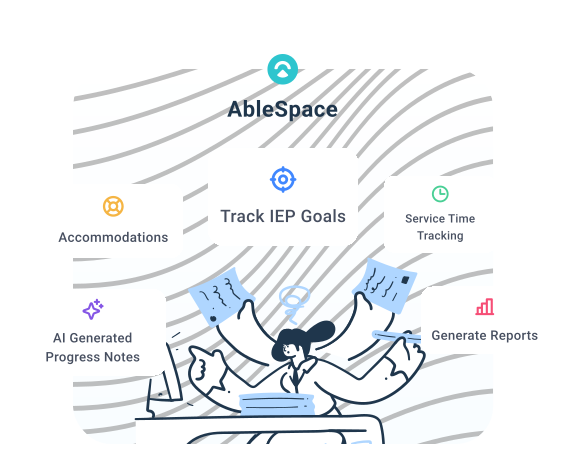
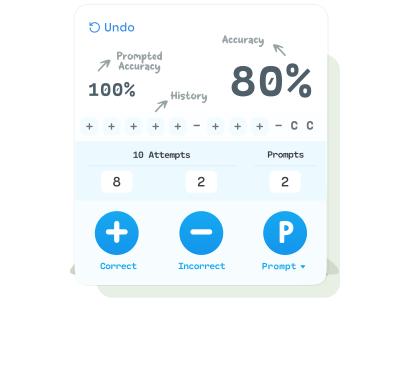
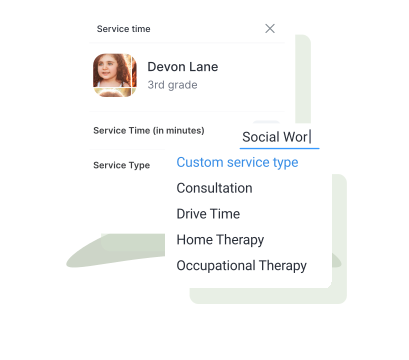
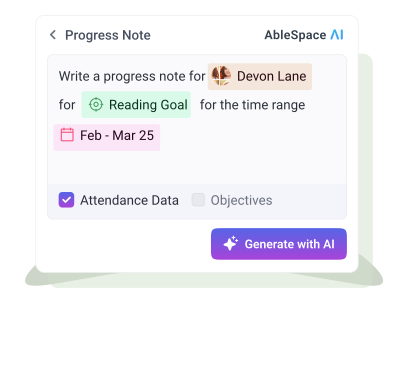
This is where teams often turn to a system like AbleSpace for support. When service notes, observation entries, and goal-related data are logged as they happen, time-stamped and tied directly to students and goals, it reduces the need to reconstruct weeks of information during progress reporting or meetings. The value is not volume, but continuity. Patterns remain visible over time, even when staff rotate or schedules shift, making it easier to respond to questions with evidence rather than memory.
Final Review
An IEP is one of the few documents in education designed to survive staff changes. Students move. Providers rotate. Coverage happens. A careful read reveals how well the plan will hold up when the original authors are no longer in the room.
Later in the year, this document will not be read from start to finish. It will be opened to answer a single question, justify a decision, or settle a disagreement. A strong first read prepares educators for those moments by identifying which sections will actually be referenced and which ones will be ignored unless clarified early.
FAQs
1) How soon should an IEP start influencing instruction after it’s received?
Immediately, but selectively. Not every section needs instant action, but services, safety-related accommodations, and legally binding supports should shape planning from day one. Goals and data systems can be layered in intentionally rather than all at once.
2) What’s the first sign that an IEP will be hard to implement as written?
When multiple sections rely on “as needed,” “when appropriate,” or unnamed staff roles. These phrases shift decision-making onto individuals instead of systems, increasing inconsistency. Early clarification prevents downstream confusion.
3) Should educators rely on past progress reports when reading a new IEP?
Past reports provide context, but they should not be treated as predictors. Changes in placement, staffing, or instructional approach can significantly alter outcomes. The IEP should be read as a plan for the present team, not a continuation of previous assumptions.