Introduction
There is a moment sped professionals know well: walking into a classroom that looks perfectly inclusive on the surface. A student with complex needs sits among peers, the lesson is running, and nothing appears obviously wrong. Yet something feels off, an underlying disconnect between the student’s presence and their participation. They’re here, but they’re not in it.
Not because anyone intends harm, and not because the student can’t access learning, but because the system around them quietly misaligns.
The inclusive education debate often gets flattened into a simple idea: placement vs participation. But that oversimplification hides the real issue. Participation doesn’t fail because a teacher forgets to call on a student, or because a worksheet wasn’t differentiated enough. Those are symptoms, not causes. The real failure is systemic, built into the way classrooms are planned, assessed, supported, and socially structured.
Inclusion breaks long before a lesson begins. And fixing it requires digging deeper than the usual clichés. This blog explores four entirely different system-level failures that create the Inclusion Illusion, and more importantly, what SPED professionals can actually do to dismantle them.
1. System Failure #1: The Invisible Cognitive Load on Teachers
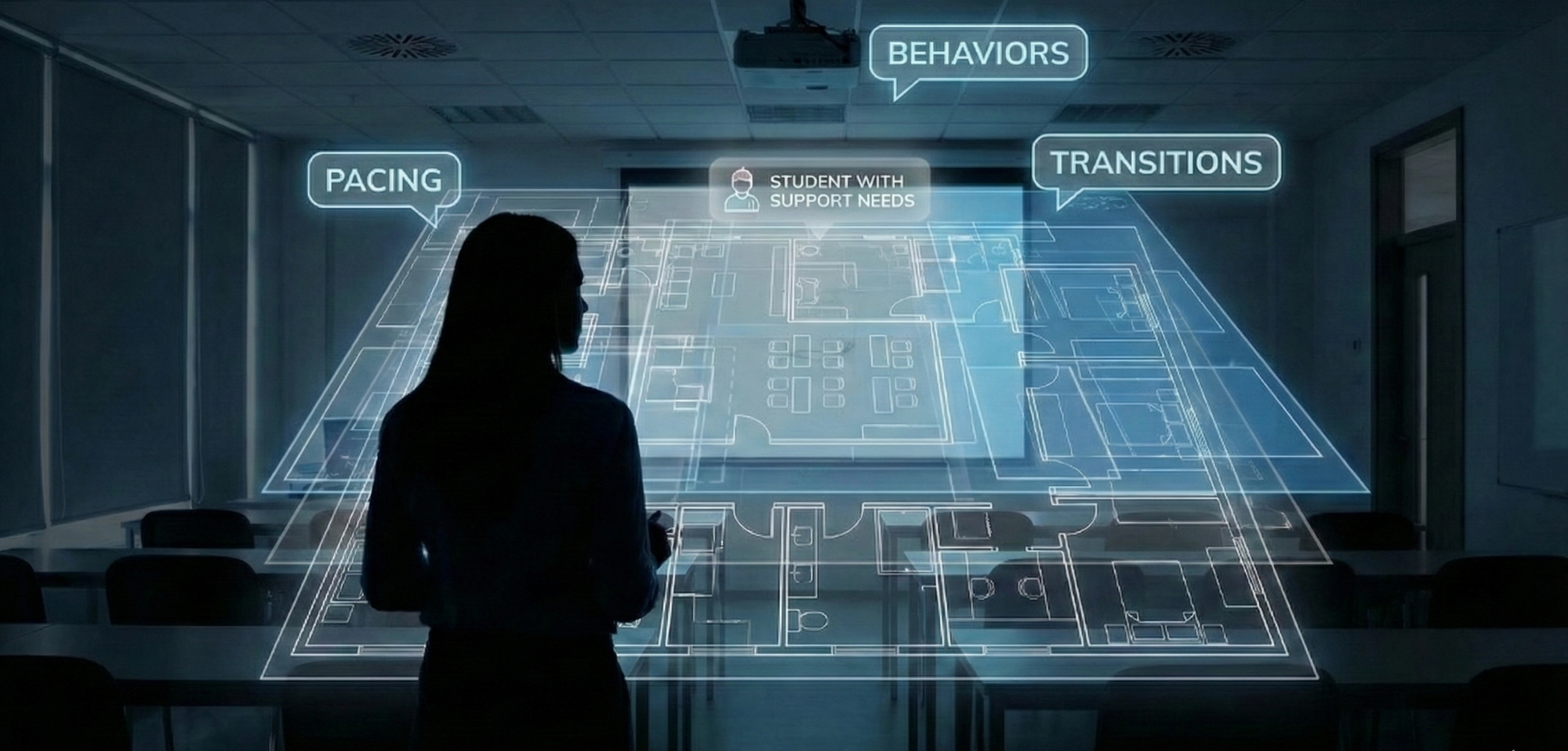
Most inclusion breakdowns start before the student even enters the classroom, inside the teacher’s working memory.
A typical general educator manages:
- pacing for 25–30 neurotypical learners,
- behavior cues for the whole group,
- transitions every 6–12 minutes,
- monitoring comprehension in real time,
- instructional delivery that must stay coherent,
- plus spontaneous problem-solving.
Now add one student whose support needs are not embedded into the lesson design. Nothing about the lesson reflected this student’s learning profile.
What happens is predictable:
The student gets sidelined, not intentionally, but because the teacher’s cognitive bandwidth is already saturated. They do not have a spare mental tab to integrate the student fluently into the flow.
What Helps (Concrete Fixes)
These solutions don’t require extra time, just structural tweaks.
a. Pre-loading participation cues
Instead of asking teachers to improvise inclusion on the fly, provide:
- one-sentence ways the student can contribute to each activity,
- a default role for every group task,
- a predictable participation routine that doesn’t need planning from scratch.
When participation is pre-engineered, it becomes automatic.
b. Instructional “batching”
Teachers can integrate multiple supports at once by batching accommodations:
- one visual that works for everyone,
- one set of sentence starters,
- one scaffold shared by the entire room.
Universal tools reduce cognitive load while increasing equity.
c. Micro-briefings
Right before class begins, the adult supporting the student’s plan (whether that’s the special educator, the co-teacher, or the para) can give the lead classroom teacher a quick 20–30 second cue about how the student will participate in an upcoming part of the lesson.
For example: “When you ask the prediction question, call on him. He'll respond using the picture card.”
These tiny, timely cues help the teacher integrate the student naturally, without extra meetings or planning time.
This is also where a subtle systems tool like AbleSpace becomes valuable, not as a product, but as a shared cognitive assistant. When teachers can see micro-supports embedded directly in a student’s goals or daily notes, they aren’t forced to store everything in memory. Cognitive load drops; inclusion becomes more natural.
2. System Failure #2: Assessments Exclude Students Before Lessons Even Begin
In many classrooms, exclusion is baked into assessments long before instruction happens.
Not because the student “can’t handle grade-level work,” but because the assessment structure itself pre-determines who can succeed.
How Assessment Creates the Illusion
Consider typical formats:
- timed warm-ups
- written exit tickets
- single-response questions
- comprehension checks that assume fast processing
- tasks requiring fine-motor output
- vocabulary-heavy test items
A student may understand the lesson intellectually but still fail the assessment format, making teachers assume the student “wasn’t participating.”
What Helps (Concrete Fixes)
a. Designing assessments for thinking, not formatting
Instead of identical tasks, use identical mental work.
Example:
If the class synthesizes a reading, the student can:
- speak the answer
- drag icons
- select from images
- match ideas
- use AAC
- demonstrate concept knowledge with manipulatives
Same cognitive demand; different access points. This is the heart of accessible assessment strategies.
b. Parallel assessments, not simplified ones
A common trap is reducing rigor to “make things accessible.”
This communicates the wrong message: The real task wasn’t for you.
Instead, create parallel assessments that test:
- the same concept,
- at the same depth,
- through a different mode of expression.
c. Assess during learning, not only after
Formative checks integrated into instruction catch learning while it happens, not after it’s too late.
This prevents the illusion that “the student wasn’t following” when the issue was simply the end-task format.
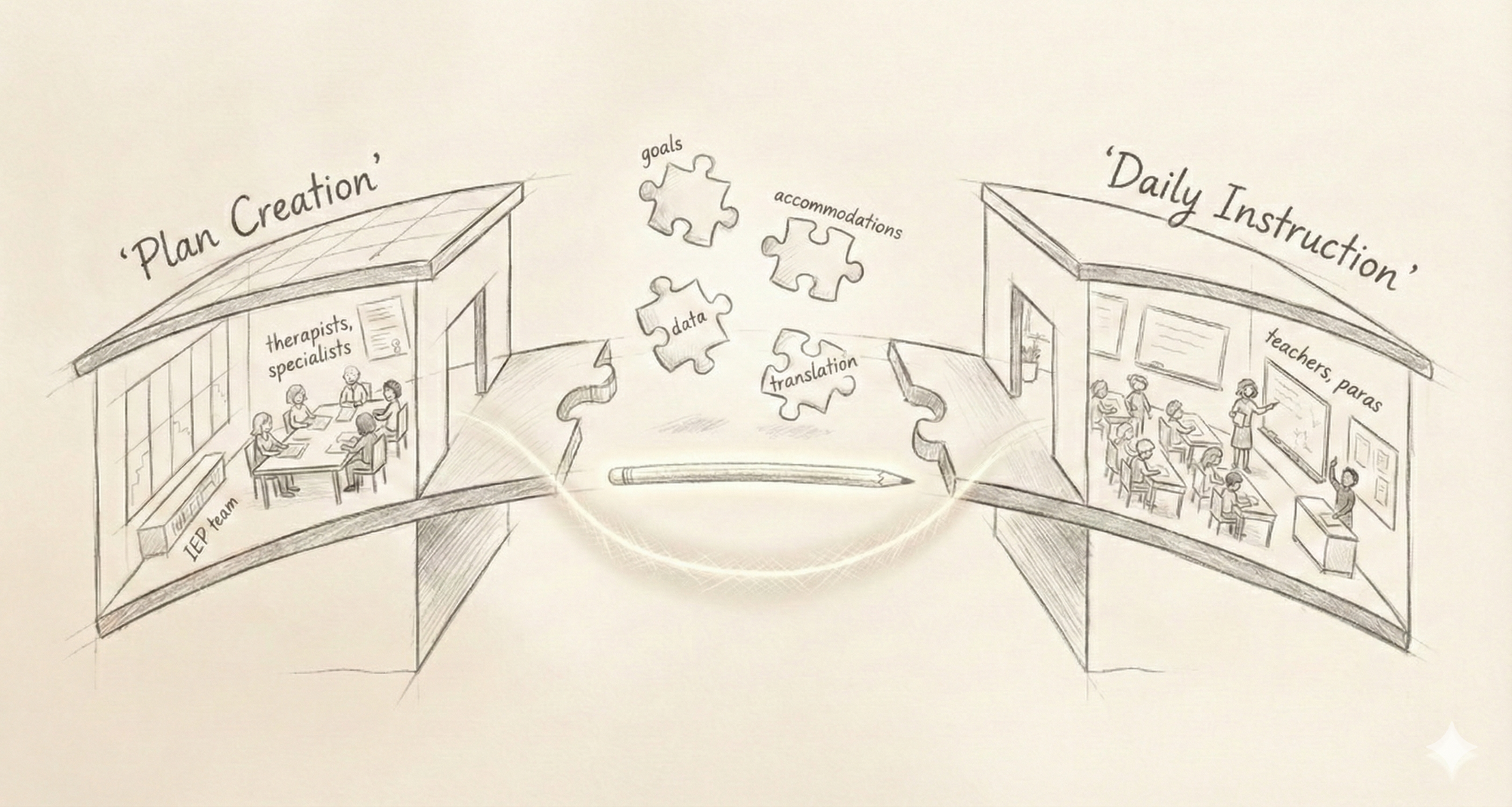
3. System Failure #3: The People Who Write the Plan Are Not the People Who Teach the Plan
This is the least-discussed root cause of the Inclusion Illusion.
An IEP or intervention plan is written by:
- a sped professional,
- a psychologist or therapist,
- sometimes the family,
- occasionally an administrator.
But the daily instruction is delivered by:
- a general educator
- paraprofessionals
- rotating substitutes
- sometimes co-teachers
The people designing supports and the people delivering them often operate on two different information streams.
This gap is where inclusion quietly collapses.
How the Gap Creates the Illusion
- Goals are written in isolation, so teachers don’t know how to translate them into lessons.
- Accommodations are listed but not contextualized.
- Paraeducators receive fragmented instructions.
- Classroom teachers guess what to prioritize.
- Daily data is collected inconsistently or not shared.
The result:
The plan exists on paper, but instruction runs on a completely separate track.
What Helps (Concrete Fixes)
a. Shorthand goal translation
Take each IEP goal and translate it into a one-line classroom cue:
- “Provide choices for communication.”
- “Use visuals before verbal instructions.”
- “Offer wait time before re-asking.”
Simplify the plan until teachers can use it mid-lesson without referencing a document.
b. Create a daily “signal system”
Teachers should have a simple way to signal:
- “This strategy worked today.”
- “This one didn’t land.”
- “He participated best during this part.”
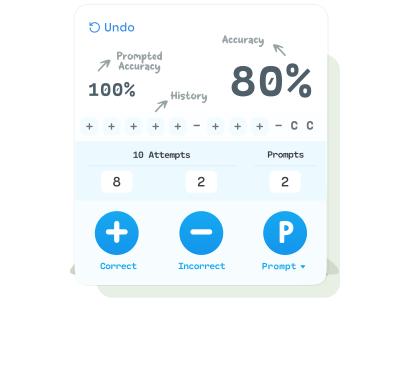
AbleSpace strengthens this system by drawing those small signals into patterns through clear, lightweight charts. Once the team can see what’s taking shape over several days, the plan becomes easier to fine-tune in the moment.
c. Co-responsibility instead of delegation
Replace the model where the para is the student’s “person.”
Instruction belongs to the whole team.
The student stops being managed and starts being taught.
4. System Failure #4: Classrooms Are Social Systems — and Many Are Built for Exclusion
Academic participation isn’t the only problem.
Social participation often collapses even faster.
Not because students are unkind, but because classrooms rarely have social architecture, intentional systems that structure interaction.
How Social Architecture Fails
- Fast-paced groupings rely on friendships, leaving some students always last-picked.
- Group roles assume uniform ability, so sped students get assigned low-value tasks.
- Communication differences create mismatches peers don’t know how to navigate.
- Unstructured moments (recess, transitions, projects) expose students to subtle isolation.
No one plans exclusion, but if schools don’t plan inclusion socially, exclusion becomes the default.
What Helps (Concrete Fixes)
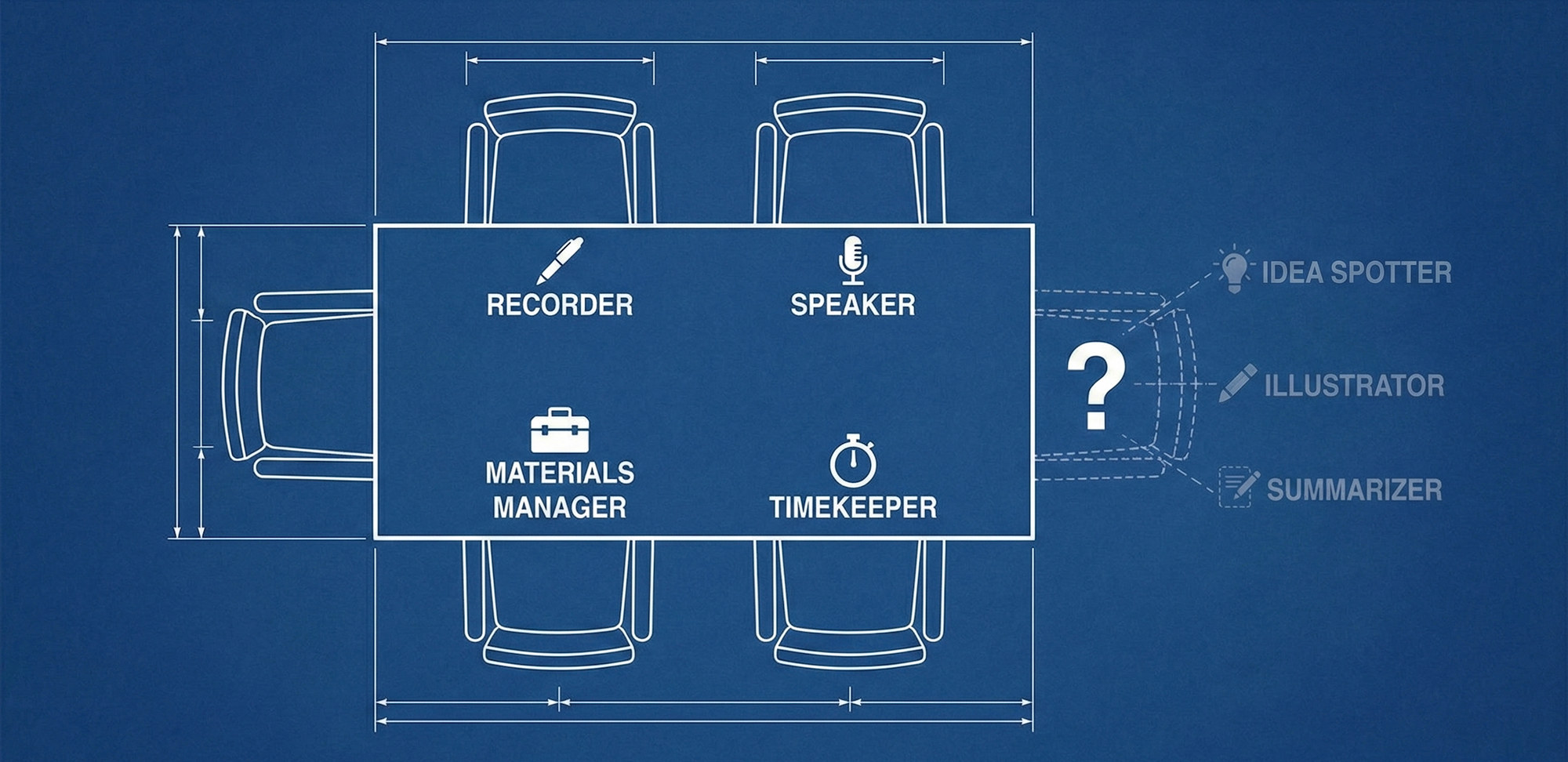
a. Anchored roles
Give students predictable, recurring roles in group tasks:
- idea collector
- materials manager
- time tracker
- illustrator
- summarizerRoles distribute cognitive and social responsibility, ensuring every student has a purpose.
b. Priority partner rotations
Pair students with peers pre-taught how to model collaboration.
Rotate partners weekly so relationships diversify.
c. Social learning scripts
Not artificial; not over-structured.
Just 1–2 sentence social expectations that peers can use when working with a student who needs more structured interaction:
“After you share, invite your partner with: ‘Your turn, what do you think?’”
“Start by offering two choices and letting your partner pick one.”
These tiny scripts give classmates something concrete to say, making peer interaction doable instead of intimidating, and unlocking moments of connection that otherwise never happen on their own.
d. Structured moments to shine
Plan specific opportunities where the student’s strength becomes the center of the activity:
- visual memory
- artistic interpretation
- unique perspective
- lived experience
- pattern recognition
When a student becomes a resource to peers, social inclusion becomes organic.
Conclusion: Inclusion Fails Where Systems Fail, and Systems Can Be Redesigned
The Inclusion Illusion was never about students lacking skills or teachers lacking goodwill.
It was about systems built without the realities of human cognition, assessment structures, instructional handoffs, and social ecosystems in mind.
When sped professionals address these four systemic blind spots:
- teacher cognitive load
- assessment design
- communication between plan-creators and plan-implementers
- classroom social architecture
inclusion stops being symbolic and becomes genuinely transformative.
Small structural shifts can change everything — not by making teachers work harder, but by making classrooms work smarter.
FAQs
1. How can SPED teams reduce general educators’ overwhelm without adding more meetings?
Most teachers don't need more time — they need micro-information delivered at the right moment. Short, 10–20 second cues before class (“Use the visual prompt today during partner work”) do more for real inclusion than hour-long PD sessions. When sped teams shift from long briefings to tiny, high-frequency nudges, participation rises and teacher stress drops.
2. How can assessments stay fair when students use different formats?
Fairness comes from shared cognitive demand, not shared task format. If every student is asked to compare, infer, or explain, the thinking is identical, even if the expression differs. When teachers plan for cognitive equivalence instead of identical output, assessments stop excluding before learning starts.
3. What should paraprofessionals focus on to avoid isolating the student?
Their primary role isn’t proximity, it’s fading smartly. Paras should shift attention toward supporting the task and group, not just the individual, so the student becomes a peer participant rather than a para-dependent learner. When paras coach the group instead of hovering, the student’s social identity changes instantly.
4. What’s one overlooked factor that predicts whether inclusion will succeed in a classroom?
The predictability of routines. Students participate more when they can anticipate when they’ll speak, how the task flows, and what the teacher expects. When routines stabilize, cognitive load drops for everyone, and the student who used to hang on the edges suddenly has the bandwidth to join the center.