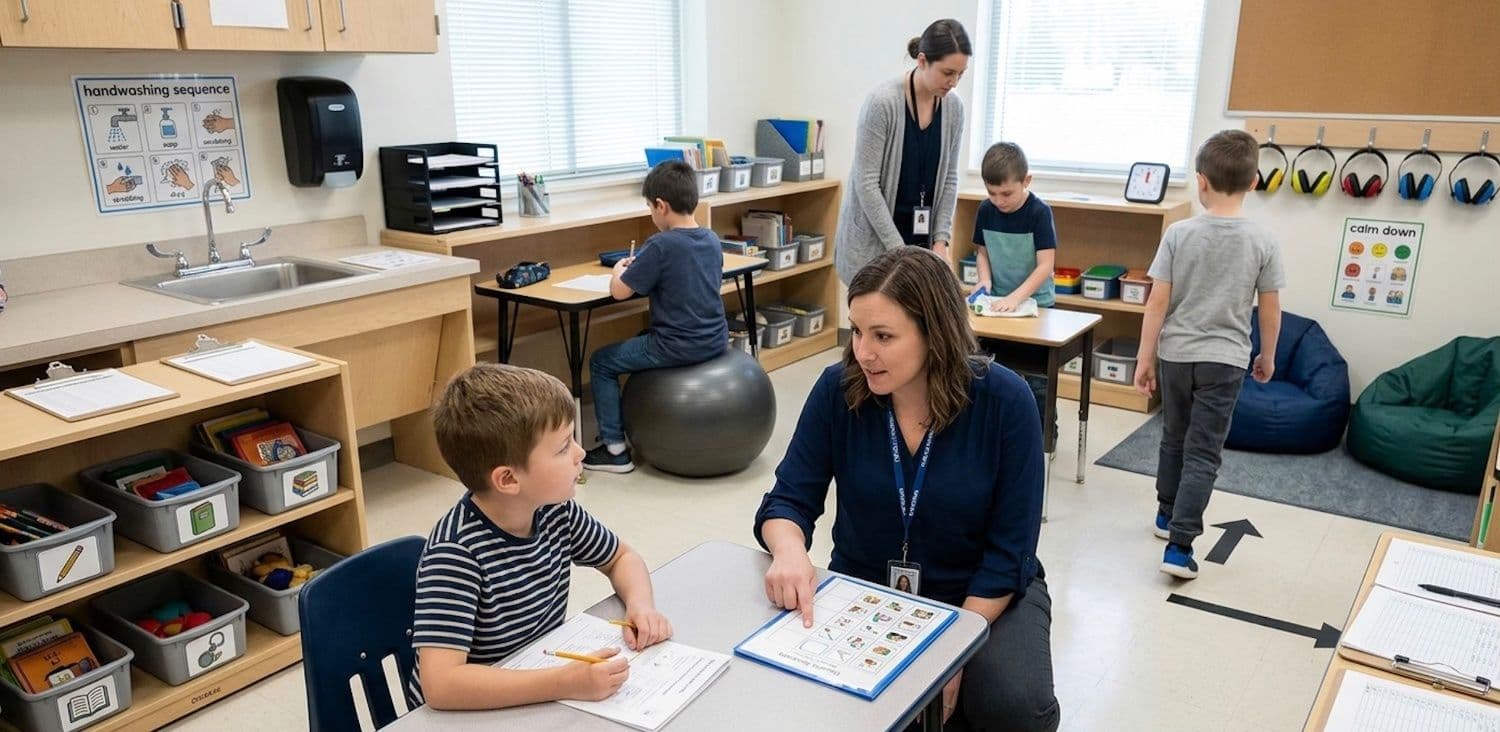
You've likely experienced that instance when you finish a reading group, help a student transition to their next activity, answer a query from a paraprofessional, address a behavioural issue, and then suddenly remember: I was supposed to collect data on that goal!
That's the reality of special education data collection.
Data collection rarely ever happens in a peaceful little window with a clipboard and one perfectly organized desk. It happens while instruction is moving, students require support, and multiple other things are competing for your attention.
The solution to this problem isn’t about looking for another 30 minutes in your already packed day. It’s about making the data collection you already need to do simpler, more purposeful, and easier to sustain.
1. Stop Trying to Collect Data on Everything
You can't always get useful information simply by collecting more data.
When you have many students, numerous IEP goals and a busy teaching schedule, attempting to capture each and every data point isn't really a solid plan. In fact, it can also turn into a distraction that takes your focus off the very student in front of you.
So, ask yourself a better question: What data do I actually need right now?
Take a look at the goals you're actively working on right now.
Which of them need to be monitored more often?
Which ones do you already have enough recent information on?
Can any of the goals be measured naturally during instruction (instead of requiring you to design a separate activity just to track data)?
This little shift in your approach can make your special education data collection process a lot less burdensome. That's because you're deciding where your attention will yield the most value.
2. Match the Data Collection Method to the Goal
Sometimes the problem isn’t that data collection takes too long; it’s that the method you’re using takes too long.
A reading accuracy goal may just need a quick percentage. An independence goal might be better captured through prompt levels. A behavior goal may call for frequency, duration, or another clearly defined measurement type.
You don’t need to write a mini essay every time a student works on one of their goals.
The best IEP data collection method is the one that gives you reliable info about the goal without making you pause teaching just to jot down every tiny detail.
Therefore, before creating yet another elaborate data sheet for iep goals, ask: What is the simplest reliable way to capture what I need to know?
That can save quite a bit of your time.
3. Build “Data Moments” Into Activities You Already Teach
When your schedule is already super tight, “find more time for data collection” isn’t really a great piece of advice.
Instead, look at the activities that are already happening in your classroom.
- During a reading group, you might collect one student’s fluency data.
- During independent work, you might document the prompt level for an independence goal.
- During a transition, you might record a useful self-regulation or behavior measure.
Try to make certain moments predictable.
After all, not every single lesson has to turn into a data-collection session. All you need is a few instances within familiar routines where you already know, This is when I’m going to grab that data point!
By doing this, you can make special education data collection feel less like an extra task to add on top of teaching and more like a small part of teaching itself.
4. Try a “One Student, One Goal” Focus
Instead of attempting to collect data for every student during every single activity, create an easy rotation system.
Example:
Monday: Student A, reading goal
Tuesday: Student B, communication goal
Wednesday: Student C, independence goal
The exact rotation, of course, will vary depending on your students' IEPs and how often their goals must be monitored. However, by setting a clear data-collection focus rather than trying to gather all the data at once, you'll save yourself from a good deal of headaches.
Otherwise, you can spend half a lesson thinking, Which goal was I supposed to track? Was it this one? Or the other one?
A focused approach like this can also make IEP goal tracking more consistent. That's because you’re less likely to collect scattered observations that don't really tell you much.
One clear focus is always better than numerous competing ones.
5. Make Your IEP Data Collection Sheets Do Less
Some IEP data collection sheets practically ask teachers to fill out a tax return during a 20-minute lesson.
If you have to find the student, locate the goal, reread a lengthy description, remember the scoring system, write your observations, and then transfer all of that into another system, the issue may not be your efficiency. The workflow itself may be too exhausting.
A good data collection system should make the next action obvious.
Think:
Find the goal → record the result → add context if needed → move on.
Not:
Find the goal → decode the sheet → write everything down → transfer it to a spreadsheet → calculate it later → try to remember what happened.
IEP goal tracking sheets should help you in seeing what's happening, rather than creating additional administrative tasks.
6. Don’t Create Work for Future You
Friday afternoon has a special talent for exposing Monday’s optimism.
You remember working on a particular goal the entire week. You know you saw the student making good progress. But now you’re staring at a blank space and trying to reconstruct what happened three days before.
That’s when data collection becomes much more time-consuming (and a lot less productive) than it needed to be.
The hidden cost of delayed recording is reconstruction during special education data collection. You've to remember which activity you used, what the student did, the number of prompts that were provided, and whether that observation even belonged to the goal you were trying to document.
Rather than telling yourself "I'll fill it in later," record the smallest useful piece of information while its details are still fresh in your mind.
A brief entry now can prevent a 20-minute memory excavation later.
7. Make special education data collection Work for you
It's true that technology can't magically add extra time in your school day. However, it certainly can eliminate some of the repetitive work surrounding progress monitoring in special education.
If you find yourself constantly searching through folders, switching between spreadsheets, locating student goals, calculating progress, or moving data from one place to another, the system itself may be eating into your time.
This is where a digital tool like AbleSpace can be useful. It keeps student information, goals, and data collection together, so you can spend less time managing the IEP data tracking process and more time using the information.
The goal isn’t faster data collection for its own sake; it’s a process that is easier to maintain.
8. Give Yourself a “Good Enough” Data Routine
Your daily data routine should support you even on a random Tuesday, not just on days when things go exactly according to the plan.
At the beginning of the week, identify the goals that require your focus. During instruction, look for your planned data moments. After the activity, capture the smallest useful data point. Finally, at the end of the week, look for gaps instead of trying to recreate the whole week.
That’s the difference between a system you mean to use and one you'll actually use.
Remember, consistent habits generally lead to better results than any last-minute heroic catch-up session.
Your Data Collection System Should Fit Your Classroom
Special education teachers don’t require a fresh reminder about the value of data. You're already well aware of that.
What matters is whether your special education data collection process truly matches your schedule and classroom.
When time is highly limited, don’t begin by asking how you can fit more of your work into your day. Ask:
- what you can simplify,
- what you can stop collecting, and
- where the data can organically fit into instruction.
Collect the right information, at the right time, and in a way you can actually use in the long term.
Because the goal isn’t to become better at finding time for data collection; it’s to build a system that needs minimum time in the first place.