The refusal does not always look dramatic. It can appear as stillness. A blank page. A head lowered just long enough to signal withdrawal. In special education classrooms, these moments accumulate quietly, and they test even the most skilled educators.
The instinct to interpret refusal as willful resistance is understandable. Schools are structured around output: completed tasks, visible progress, measurable productivity. When output stalls, urgency rises.
But refusal is rarely random. It tends to emerge at predictable pressure points, places where instructional demand collides with cognitive load, skill gaps, or emotional history. In these moments, behavior is not opposing instruction. It is reacting to it.
This blog examines how to decode that reaction, and how to respond in ways that strengthen access rather than escalate control.
Why Refusal Happens in SPED Settings
Students receiving specialized instruction often navigate layers of challenge invisible to peers. Work refusal frequently emerges at the intersection of several factors:
- Skill deficits masked as noncompliance. A reading comprehension task may actually require decoding skills not yet mastered.
- Executive function overload. Multi-step tasks without visual scaffolds can overwhelm working memory.
- Task ambiguity. Directions that seem clear to adults may feel opaque to students.
- Demand sensitivity or trauma response. Direct prompts can activate avoidance if prior experiences associated demands with failure or shame.
- Lack of perceived relevance. Students disengage from tasks that feel disconnected from meaningful goals.
In these contexts, refusal becomes protective. It shields the student from exposure, confusion, or emotional overload.
The instructional response must therefore target the pressure point, not the behavior.
Strategy 1: Separate the Learning Target from the Performance Format
Many refusals are not about content. They are about output.
A student may understand the science concept but refuse the written explanation, grasp the math operation but avoid the full worksheet, or generate rich verbal ideas yet shut down when asked to write a paragraph.
When the mode of expression becomes the barrier, refusal surfaces.
To address this:
- Identify the actual learning target.
- Offer alternate performance pathways that assess the same skill.
- Temporarily remove the most taxing modality while building capacity in it separately.
For example, if the goal is sequencing events, allow oral sequencing with visual cards before requiring written sentences. If the target is problem-solving, reduce unnecessary writing demands by providing partially completed problems.
This shift respects rigor while acknowledging processing differences. Over time, capacity can be expanded, but not at the cost of immediate shutdown.
Strategy 2: Reduce Cognitive Friction Within the Task Itself
Not all overload is visible.
Cognitive friction accumulates in subtle ways: dense formatting, inconsistent directions, unclear visual hierarchy, unnecessary decorative elements, excessive white noise in worksheets.
Students with attention regulation challenges or processing delays often experience this as static.
Refusal sometimes decreases simply by:
- Increasing spacing between items.
- Limiting one task per page.
- Highlighting key instructions.
- Removing extraneous visuals.
- Using consistent templates across days.
These adjustments do not dilute rigor. They streamline access.
When refusal clusters around specific task types, examining formatting and visual complexity often reveals more than examining behavior.
Strategy 3: Recalibrate the Ratio of Effort to Success
Some students refuse because the effort-to-reward ratio feels misaligned.
If every task requires maximal exertion with delayed reinforcement, disengagement becomes logical.
Instruction can be redesigned to recalibrate this ratio:
- Insert one or two “guaranteed-success” problems into harder sets.
- Mix new learning with skills the student has already mastered.
- Make progress physically visible as the task unfolds.
- Break long assignments into clearly defined sections with brief feedback after each part.
When students experience frequent, authentic success, stamina increases. Not because they were persuaded, but because the neurological cost feels sustainable.
Strategy 4: Teach Demand Negotiation as a Skill
Students who refuse often lack structured ways to modify demand safely.
Without a taught alternative, the only available strategy becomes escape.
Instead of viewing negotiation as defiance, treat it as communication to be shaped.
Explicitly teach:
- How to request fewer items.
- How to ask for a model.
- How to delay a task appropriately.
- How to identify when help is needed before shutdown.
Provide scripts. Practice them during low-stress moments. Reinforce their use.
When students learn that tasks can be collaboratively adjusted within boundaries, refusal shifts from absolute avoidance to calibrated participation.
Strategy 5: Align Skill Goals with Daily Academic Demands
Refusal often exposes a misalignment between IEP goals and daily classroom tasks.
If executive function, task initiation, or sustained attention are areas of need, but instruction consistently assumes independence in those domains, refusal is predictable.
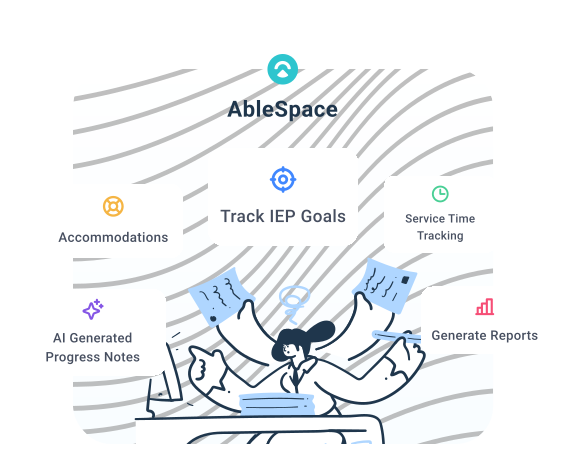
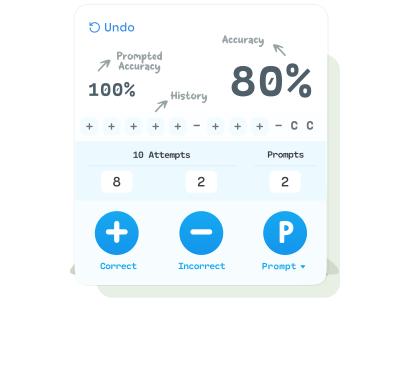
When progress monitoring captures not just accuracy but level of support required, instructional planning becomes more precise. In systems such as AbleSpace, prompt-level documentation and goal tracking live together, making it easier to see whether scaffolds are still essential. Daily assignments can then mirror demonstrated independence, reducing preventable overload.
Conclusion
Patterns of refusal often surface weeks before data dashboards reflect academic regression. They are early signals, quieter than failing grades, but far more instructive. When educators respond with curiosity instead of urgency, classrooms shift from managing resistance to designing access. That shift does more than increase task completion. It changes how students experience themselves as learners.