“I’ll enter the data later” isn’t procrastination.
It’s a rational response to an irrational workflow.
In special education settings, data rarely fails because professionals forget to document. It fails because documentation is structurally separated from the moment it’s meant to represent. The longer that gap exists, the less trustworthy the data becomes, not morally but mechanically.
What Actually Breaks When Data Is Delayed
Delayed data doesn’t just lose detail. It changes shape.
When entries are made hours later, three quiet distortions tend to appear:
- Compression: Multiple incidents collapse into a single summary because separating them feels tedious or unclear.
- Normalization: Unusual intensity gets averaged down. Mild behaviors get remembered as “typical.”
- Outcome bias: If the situation resolved well, the antecedent and response are remembered as cleaner than they were.
None of this is intentional. It’s how recall works under cognitive load. By the time documentation happens, memory has already started editing.
This is why teams sometimes review months of “consistent” data and still feel blindsided by a student’s regression. The data didn’t lie, it quietly simplified.
The Hidden Cost: Data That Can’t Be Used Midstream
The bigger issue with delayed data isn’t accuracy alone. It’s timing.
Data entered days later can’t inform decisions made that same week. That matters more than most teams realize. Early signs of escalation, brief windows of progress, or short-lived triggers often disappear before anyone has a chance to respond.
By the time delayed entries are reviewed, teams are no longer adjusting, they’re reacting. Interventions grow heavier. Support plans become more drastic than the situation initially required.
This is how systems drift toward intensity, not because students need it, but because feedback loops move too slowly to catch nuance.
Why “Just Write It Down Later” Keeps Failing as Advice
Advice to “be better about documentation” assumes the issue is discipline or prioritization. In reality, it’s design.
Documentation often fails because it asks educators to:
- stop instruction at unnatural moments,
- switch tools mid-flow,
- remember details while managing behavior,
- or reconstruct events long after context has faded.
When the cost of entry is high, deferral is rational. No amount of reminders fixes a system that competes with real-time decision-making.
This is also why on-the-go data logging is often misunderstood. The benefit isn’t speed or efficiency. It’s preserving information before interpretation creeps in. A short note captured immediately, imperfect but accurate, often holds more value than a detailed entry written later.
The Less Obvious Problem: Decision Lag
Delayed data creates a lag not just in documentation, but in confidence.
When teams don’t trust the precision of their data, meetings become tentative. Discussions orbit impressions instead of evidence. Decisions slow down.
Ironically, this often leads to more documentation requests, longer notes, and higher pressure, none of which address the root issue. What’s missing isn’t volume. It’s proximity to the moment.
The Compliance Myth
Delayed data often feels safer than missing data, especially in compliance-heavy environments.
But from an audit or legal standpoint, reconstructed documentation is fragile. Timestamp gaps, inconsistent language, and retrospective entries raise more questions than real-time, imperfect logs ever would.
Accuracy protects professionals far more than polish.
How Small Design Changes Shift Behavior
The systems that reduce delayed entry don’t demand better habits. They remove friction.
They allow educators to:
- capture partial observations without finishing a full narrative,
- log during transitions instead of after hours,
- store context immediately, even if interpretation comes later.
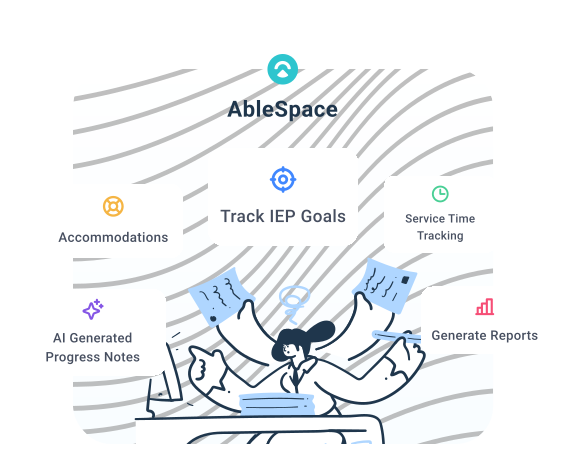
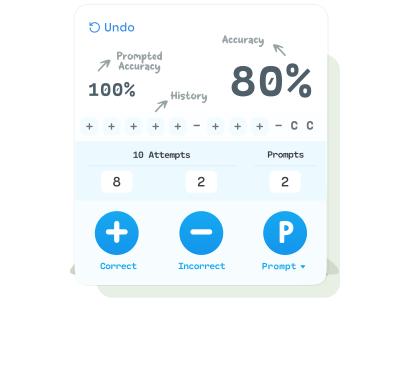
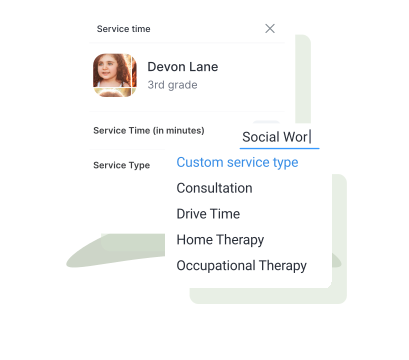
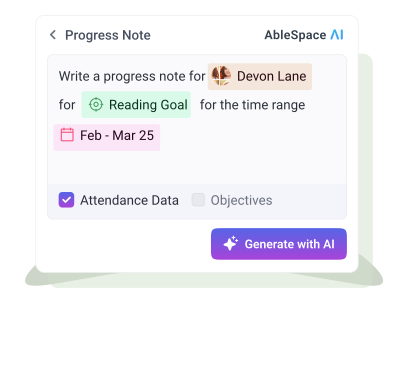
This is why some teams rely on tools like AbleSpace in practice. Educators can log behavior data, frequency counts, or short observation notes as they happen, without completing a full report in the moment. Those entries are automatically time-stamped, aggregated into graphs, and used to support progress reports later. The system handles organization so documentation is based on real events rather than reconstructed summaries.
Final Word
Silence in data doesn’t affect all information equally. It filters out quiet progress, short-lived successes, and context-heavy moments that don’t demand attention. What remains are extremes: spikes, crises, and moments that force reaction.
Over time, systems trained on delayed data become optimized for managing breakdowns rather than supporting growth. This isn’t a failure of intent. It’s a predictable outcome of what gets captured late, and what never gets captured at all.
FAQs
1) Can imperfect, real-time data create problems later?
Only if it’s treated as final. Real-time data works best when it’s understood as raw input, not a polished conclusion. Teams that separate capture from interpretation tend to make fewer corrective edits down the line.
2) How does delayed data affect functional behavior analysis outcomes over time?
When documentation is entered late, FBAs tend to overemphasize high-impact events and underrepresent routine conditions. This skews hypotheses toward crisis-driven functions instead of everyday instructional or environmental factors.
3) How does delayed data impact equity across students?
Students with frequent or intense behaviors tend to dominate retrospective documentation. Quieter students, incremental progress, and low-frequency concerns are more likely to go undocumented and under-supported.